
Finding out where your change journey is breaking down, and what to fix next
Every change plan looks convincing on paper. The timeline is tidy, the goals are clear, and the slides are polished. Then real people start living with it, and the plan meets daily life.
In my earlier post, The Change Quest: A Shared Journey Through Change, I described a human-centred way to understand what is changing, who is affected, and how people can be supported along the way. It gave leaders, teams, and employees a shared map for a journey that rarely runs in a straight line.
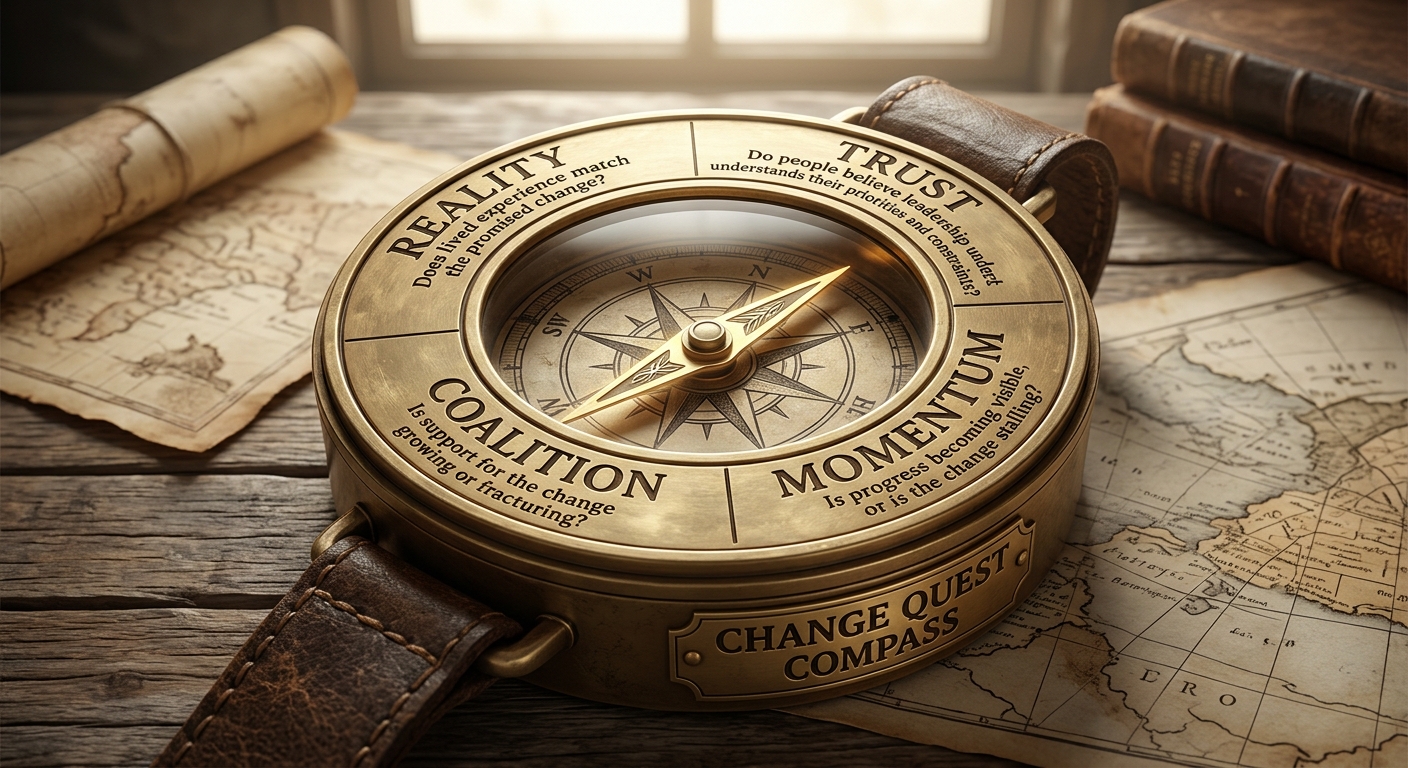
This post takes the next step. The Change Quest is no longer only a way to describe the journey. It is also a way to diagnose it. The Change Quest Method provides the route. The Quest Compass shows where that route is working, where it is failing, and what deserves attention next.
Why “Quest” Matters
The word quest is central to the Change Quest because it captures what conventional change management often misses: change is not simply a trip from Point A to Point B.
Sir Ken Robinson described a quest as a journey with an uncertain outcome. On an ordinary trip, the destination and the route are known. A quest is a journey of discovery. Travellers may set out with a clear goal, get blown off course, run into the unexpected, and sometimes arrive somewhere better than they first imagined.
That is why the Change Quest does not treat change as a fixed project plan. A project assumes that if leaders define the scope, assign the tasks, announce the plan, and manage the schedule, the change will happen. A quest assumes something more realistic: people will hit obstacles, feel losses, need support, question the destination, and commit only when they can see the journey is worth taking.
The quest metaphor makes room for uncertainty, discovery, adaptation, and human experience. It accepts that a change may begin with one destination and reveal a better one along the way.
From a Map to a Compass
The original Change Quest gave people a shared map. It helped them answer six practical questions:
- Where are we going?
- Why does this change matter?
- Who is affected?
- What role do I play?
- What support will I receive?
- How will we know whether it is working?
A map shows the route. A compass tells you when you are drifting, when conditions have shifted, and when it is time to adjust course.
That difference matters because change is never a straight line. Feedback may expose a risk no one saw. Training may reveal that a process is far too complicated. A rollout may need a new plan halfway through. None of these is a failure. Each is a chance to learn, and the Compass makes that learning deliberate instead of accidental.
From Eight Steps to Eight Quests
My first article called the model an “eight-step process.” I now call it the Change Quest Method, made up of eight connected quests. The shift is more than wording. A step sounds like something you finish and leave behind. A quest is something you move through, learn from, and revisit as conditions change.
The eight quests remain:
- Understand the Mission — Define what is changing, why, who is affected, and what success looks like.
- Assess the Terrain — Gauge readiness, trust, fatigue, capacity, resistance, and the realities people already face.
- Map Your Quest Roles — Identify sponsors, navigators, explorers, protectors, champions, and impacted players.
- Understand the Quest Landscape — Map who can help, block, benefit from, or be harmed by the change.
- Design the Quest-Flow — Communicate both the Loot and the Peril, and build a genuine feedback loop.
- Skill-Up the Quest Team — Give people the knowledge, tools, confidence, and support to succeed in the new reality.
- Launch the Quest Campaign — Sequence the change, test it, learn from early feedback, and adjust before resistance hardens.
- Reinforce the Quest — Make benefits visible, address setbacks, and make the new way of living or working normal.
The Compass does not replace these quests. It helps you decide which quest needs attention when the journey is not unfolding as planned.
Why We Need a Compass
Change rarely fails simply because people dislike the destination. It fails when the mission is unclear, the terrain is misread, or the wrong people are at the table. It fails when a process or technology creates needless friction, when policy makes progress impossible, or when the promised benefits never reach daily life.
A plan alone cannot catch any of that. You need a way to read the journey as it unfolds.
The Quest Compass is a human-centred diagnostic lens. It does not compete with established change models. It simply asks a different question:
Where is the quest breaking down for the people living it, and what needs to change next?
Two Levels of Diagnosis
The Compass works on two connected levels. The first looks at how change actually feels to people.
The Human Conditions
| Condition | Core question | What it reveals |
| Reality | Does people’s lived experience match the promised change? | Whether the intended benefit is real, visible, and credible |
| Trust | Do people believe leadership understands their priorities and constraints? | Whether the change is seen as fair, competent, and worth following |
| Coalition | Is the group supporting the change growing, holding, or quietly fracturing? | Whether key stakeholders are engaged or slowly disengaging |
| Momentum | Is concern turning into organized action, or is progress becoming visible? | Whether feedback, adoption, and benefits are building or stalling |
These four conditions are the heart of the Compass, because people do not experience change as a project plan. They experience it as a shift in their daily work, home life, community, or public services.
The Enabling Domains
The second level examines the forces that make those human conditions possible.
| Domain | Core question | What it reveals |
| People | Who is affected, what do they need, and how will they experience the change? | Whether the right people are engaged, capable, and supported |
| Process | How will work, decisions, routines, or services change? | Whether the new way of working is clear, practical, and connected |
| Technology | What tools, systems, data, and infrastructure enable or constrain the change? | Whether technology helps people succeed or creates new barriers |
| Policy | What rules, authorities, standards, incentives, and safeguards shape the change? | Whether policy enables the change, restrains it, or causes unintended harm |
Together, the two levels reveal more than whether a change is progressing. They show whether it was designed well enough for people to succeed inside it.
One Compass, Many Journeys
The Compass is not only for organizations. The same human conditions and enabling domains can help people make sense of change in their personal lives, workplaces, communities, and political systems.
| Compass element | Personal lens | Organizational lens | Political lens |
| Reality | Does my daily experience match the life I am trying to create? | Do employees experience the promised improvement in their work? | Do citizens experience the promised improvement in their communities and households? |
| Trust | Do I trust myself, my supports, and the path I have chosen? | Do employees trust leaders to listen, decide fairly, and follow through? | Do people trust institutions to act competently, fairly, and accountably? |
| Coalition | Who can support, challenge, or help sustain my change? | Who sponsors, guides, champions, resists, or is affected by the change? | Who has influence, who benefits, who bears the costs, and who can build or block support? |
| Momentum | Am I making visible progress, or losing motivation and slipping back into old habits? | Is adoption growing, feedback improving the change, and benefit becoming visible? | Is public concern turning into organized action, or is progress showing up in people’s lives? |
| People | Do I have the confidence, relationships, and support to make the change? | Are the right people engaged, capable, and supported? | Can affected communities take part, be heard, and access support? |
| Process | Do my routines, habits, and decisions line up with the change? | Have workflows, decisions, and service practices been redesigned for the new way of working? | Are programs, rules, and service pathways practical and connected? |
| Technology | Do the tools I use help or hinder the change? | Do systems, data, and digital tools help people succeed? | Do public platforms, records, and digital services make participation and delivery easier? |
| Policy | What personal commitments, boundaries, or agreements shape my choices? | What governance, compliance, and decision rights shape the change? | What laws, regulations, mandates, rights, and accountability arrangements shape the outcome? |
The point is simple: the Compass is not just for executives or change practitioners. It can guide a person facing a major life decision, a manager leading a team into a new way of working, or a government trying to earn public trust while delivering reform.
The language shifts from setting to setting, but the diagnostic questions stay the same. In each one, the Compass asks whether lived reality, trust, coalition, and momentum are strong enough, and whether the people, processes, technology, and policy around them make success possible.
How the Compass Connects to the Quests
The Compass is not a second checklist stacked on top of the Method. It is a way to use each quest as a diagnostic tool.
| Quest | Compass question | What it may reveal |
| Understand the Mission | Is the purpose clear, honest, and meaningful to those affected? | A mission that clashes with lived reality |
| Assess the Terrain | Are readiness, capacity, trust, and resistance understood? | Hidden fatigue, skill gaps, or barriers |
| Map Your Quest Roles | Who is responsible, influential, affected, or able to help? | Excluded voices or an overly narrow coalition |
| Understand the Quest Landscape | Who could help, block, benefit, or be harmed? | Power dynamics, competing priorities, or hidden risks |
| Design the Quest-Flow | Does communication address both benefits and fears? | A message that promises Loot but ignores Peril |
| Skill-Up the Quest Team | Do people have what they need to live or work in the new way? | Gaps in training, access, support, or capacity |
| Launch the Quest Campaign | Is the change sequenced, responsive, and open to learning? | Costs arriving before visible benefits |
| Reinforce the Quest | Are benefits visible, sustained, and reinforced? | A change that launches but never sticks |
This connection is what makes the Compass useful. It does not stop at “trust is low.” It helps you trace why: an unclear mission, a poorly designed process, inaccessible technology, a policy constraint, or a failure to listen and respond.
Policy Belongs on the Map
The original Change Quest was written mostly with organizations in mind. This evolution makes its reach clearer for personal change, community change, and public policy.
Change management often treats policy as background noise, something handled through compliance, approvals, and governance. In the Change Quest, policy is part of the terrain itself. It asks:
- What rules, mandates, or authorities make this change possible?
- What rules make it harder, slower, or more costly?
- Who has the power to decide, approve, fund, challenge, or stop it?
- What rights, protections, incentives, and accountability measures affect people’s willingness to take part?
- Does the policy create unintended consequences for the people it is meant to serve?
People, process, and technology cannot deliver an outcome if the policy is unclear, contradictory, underfunded, or misaligned. Policy can create Loot, create Peril, widen or narrow opportunity, and decide whether a change is possible at all.
Loot and Peril
At the centre of the Method sits a simple idea: every change brings both Loot and Peril.
Loot is what people hope to gain: security, opportunity, freedom, recognition, health, prosperity, better tools, or a stronger future.
Peril is what people fear losing or must endure: income, control, status, stability, competence, familiar routines, relationships, or a sense of belonging.
Change communication tends to polish the Loot and downplay the Peril. But people do not meet change as a slide deck, a policy announcement, or a New Year’s resolution. They meet it through what they must give up, what they are asked to learn, and whether the promised benefit arrives in time to matter.
A credible Quest-Flow does not hide the Peril. It names it, explains it, reduces it where possible, and shows a believable path to the Loot.
How It Complements Other Models
The Compass is not here to replace the established change models. It adds a broader diagnostic question to them.
Kotter’s model excels at explaining how leaders mobilize large-scale change: creating urgency, building a guiding coalition, communicating a vision, removing obstacles, generating short-term wins, and anchoring change in culture. Its central question is how do leaders create momentum?
Prosci’s ADKAR model excels at diagnosing individual adoption through Awareness, Desire, Knowledge, Ability, and Reinforcement. Its central question is where is this person stuck?
The Quest Compass asks whether the mission, people, processes, technology, and policy line up with what people actually experience. Its central question is what is stopping people from experiencing the intended benefit?
| Model | Central question | Main lens | What the Compass adds |
| Kotter | How do leaders mobilize large-scale change? | Urgency, coalition, vision, short-term wins, anchoring | A lens for lived reality, trust, coalition health, and momentum |
| ADKAR | Where is an individual stuck in adopting change? | Awareness, Desire, Knowledge, Ability, Reinforcement | A wider view of the process, technology, policy, and power that enable or block adoption |
| Quest Compass | Where is the quest breaking down for the people living it? | Reality, Trust, Coalition, Momentum; People, Process, Technology, Policy | A link between human experience and the systems, rules, and tools that shape it |
In practice, a leader can use all three: Kotter to mobilize the organization, ADKAR to see where people need support, and the Compass to check that the whole system supports the people inside it.
Lead with Personal Power
Sponsors matter. They set direction, make decisions, provide resources, remove barriers, and signal that the change is important. But a title alone does not win hearts.
Positional power comes from a role, a budget, or a reporting line. Personal power comes from trust, credibility, relationships, experience, honesty, and respect. The gap between them is often the gap between compliance and commitment.
Positional power still has its place. Leaders must make choices, set priorities, and hold people accountable. Yet people rarely commit to a change just because someone senior told them to. They may comply. They may attend the training, use the new system, or follow the new rule because they feel they have no choice. But compliance alone does not make change last.
Personal leadership builds deeper commitment. It means being clear about why the change matters, listening to concerns, acknowledging that the change is hard, and staying involved after launch. It means proving through actions, not just words, that people’s experience and feedback count.
In a personal quest, that may mean being honest with yourself and asking for help. In an organization, it may mean leaders listening to frontline staff. In politics, it may mean governments treating public concern as evidence to learn from, not opposition to dismiss.
Use Language People Understand
Change professionals rely on useful but technical words: stakeholders, readiness, capability building, adoption, deployment, reinforcement. Project teams know what these mean. Employees, managers, and citizens often do not.
If people cannot follow the words, they cannot follow the journey. That is why the Change Quest Method uses plain language and a simple story. It gives people terms they can remember, repeat, and use.
| Technical language | Change Quest language | What it means |
| Change vision and scope | Understand the Mission | Be clear about where we are going and why |
| Readiness assessment | Assess the Terrain | Understand what we face before we begin |
| Stakeholder analysis | Map Your Quest Roles | Know who is involved, affected, and able to help |
| Influence and power mapping | Understand the Quest Landscape | Identify supporters, concerns, obstacles, and informal leaders |
| Change-management plan | Design the Quest-Flow | Plan how people will learn, receive information, and give feedback |
| Capability building | Skill-Up the Quest Team | Give people what they need to succeed |
| Implementation or deployment | Launch the Quest Campaign | Introduce the change in planned stages |
| Reinforcement and adoption | Reinforce the Quest | Help the new way of living or working become normal |
This is not about making change management less serious. It is about making it easier to grasp. Plain language is a form of respect. It helps a manager explain a change to a team, a leader explain a policy to a community, and a person explain a hard decision to family and friends.
A Journey That Keeps Going
The final quest, Reinforce the Quest, is not really an ending. It is the start of the next round of learning.
Every change has intended results: a better service, a simpler process, a stronger team, lower costs, improved health, a community that meets a new need. But every change can also produce consequences no one planned. A new process may solve one problem while creating extra work elsewhere. A digital tool may improve reporting while making frontline tasks harder. A new structure may clarify accountability for some and confuse others. A policy may reach its goal while imposing hardship on a different group.
These effects are rarely obvious at the start, which is why the listening must continue after launch. What is working? What is not? Who is benefiting, who is struggling, and what new problems have appeared?
Unintended consequences are not automatically failures. They are part of learning. What matters is whether people are willing to see them, talk about them honestly, and adjust.
The Quest Compass Promise
The Compass does not promise that change will be easy, linear, or welcomed by everyone. It promises something more useful: a way to see whether the journey is working for the people living it.
It moves leaders past asking, “Have we completed the plan?” and toward a better question:
Are people experiencing this change as progress, pain, or abandonment, and what must change so they feel the Loot and not only the Peril?
Because in the end, change is not won in a boardroom, on a project plan, or in a policy announcement. It is won or lost at the kitchen table, on the front line, and in the everyday experience of the people asked to make the journey.


