
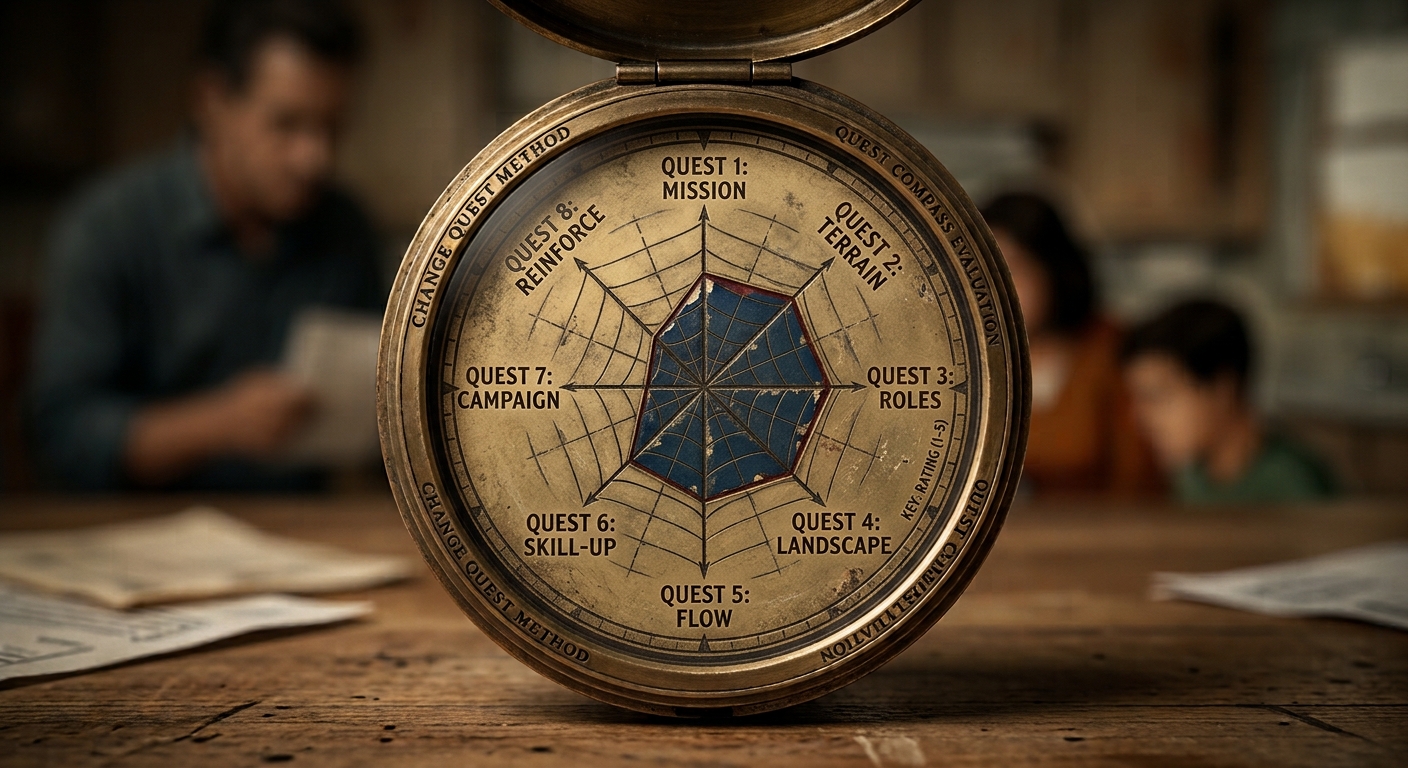
A post-midterm evaluation through the Change Quest Method and Quest Compass
The 2026 midterms were more than an election result. They were a failed national Change Quest.
The administration entered the campaign with an ambitious narrative: project strength abroad, reshape international trade, confront Iran, and restore confidence in the American economy. Many voters, however, were living a different story at home. They faced elevated fuel prices, persistent inflation, and costly mortgages. They also perceived a leadership preoccupied with distant conflicts while household budgets deteriorated.
The AP Voter Poll captured that disconnect with unusual clarity: about nine in ten voters described the cost of living as a “crucial” or “major” factor in their congressional vote, and most believed that Trump’s policies had weakened the economy and fuelled inflation.[1]
In change-management terms, this is what happens when an initiative loses the very people it was designed to serve.
The Change Quest Method and the Quest Compass offer a useful framework for understanding why. Change seldom fails simply because people dislike the destination. It fails when the mission is unclear, the terrain is misjudged, the wrong stakeholders are engaged, policy generates avoidable Peril, and the promised benefits never materialize in everyday life.
Quest 1: Understand the Mission
Every Change Quest begins with a demanding set of questions: what exactly is changing, who will be affected, why the change is necessary, and what success would actually look like.
The administration’s stated mission was national strength and economic renewal. For many voters, however, the lived mission became paying more at the pump, paying more at the grocery store, and postponing the purchase of a home.
The Iran conflict pushed energy costs higher, while tariffs, inflation, and elevated interest rates compounded the strain. Voters were asked to accept immediate economic pain in exchange for long-term strength, without a convincing path to near-term relief.
Quest Compass
| Condition | Assessment |
| Reality | Weak. The promise of strength and renewal did not match voters’ experience of rising costs. |
| Trust | Weak. About two-thirds said Trump did not have the right priorities.[1] |
| Coalition | Narrowing. Key parts of the 2024 coalition were drifting away.[2] |
| Momentum | Declining. Dissatisfaction was becoming a decisive electoral force. |
Rating: 2/5. The mission worked as a slogan but contradicted voters’ daily experience.
Quest 2: Assess the Terrain
In Change Quest language, this step is the Scout’s Report: before launching any campaign, a leader must determine where the ground is firm, where it is unstable, and where resistance is beginning to form.
The terrain in 2026 was financial rather than ideological. About eight in ten voters reported that inflation had caused their households moderate or severe hardship. About three-quarters rated the economy “not so good” or “poor,” and about two-thirds attributed rising prices to Trump’s policies.[1]
For a voter worried about filling a truck, buying groceries, or renewing a mortgage, foreign policy is never an abstraction. It arrives as a monthly bill.
Quest Compass
| Condition | Assessment |
| Reality | Weak. Household costs were the central lived experience. |
| Trust | Weak. Voters linked their economic strain to the administration’s policies.[1] |
| Coalition | Under pressure. Support was slipping among key groups.[1] |
| Momentum | Declining. Economic concern was shaping vote choice.[1] |
Rating: 2/5. The quest underestimated the political force of household budgets.
Quest 3: Map Your Quest Roles
A successful quest requires far more than a single leader. It depends on Sponsors, Navigators, Explorers, Protectors, Champions, and, most important, the Impacted Players who must live with the outcome.
The Republican coalition contracted around the presidency while key constituencies drifted away. Young voters shifted sharply toward Democrats, with about seven in ten voters under 30 supporting Democratic House candidates. About six in ten Hispanic voters did the same.[2]
Too many voters were treated as an audience to persuade rather than as Impacted Players. Their fears, priorities, and daily realities should have shaped the plan from the beginning.
Quest Compass
| Condition | Assessment |
| Reality | Weak. Many voters felt the costs of change but not its benefits. |
| Trust | Weak. Voters doubted that leaders understood their priorities.[1] |
| Coalition | Fracturing. Young and Hispanic voters moved away from the Republican coalition.[2] |
| Momentum | Shifting. Opposition became electorally decisive. |
Rating: 2/5. The quest party was too narrow for a national change effort.
Quest 4: Understand the Quest Landscape
Quest 4 asks who holds influence, who is affected, who can help, and who is positioned to block progress.
The blockers were visible well before election day. They included independents seeking change, households squeezed by rising prices, voters concerned about democratic accountability, and communities absorbing tariff-related costs. About seven in ten voters said Congress was not doing enough to provide checks and balances on the presidency.[1]
The administration largely interpreted this resistance as partisan opposition. Much of it was feedback, a signal that the quest itself was producing outcomes voters did not want.
Quest Compass
| Condition | Assessment |
| Reality | Weak. The costs of policy were visible in daily life. |
| Trust | Weak. Voters wanted stronger checks on presidential power.[1] |
| Coalition | Fracturing. Opposition spanned party, age, and demographic lines.[2] |
| Momentum | Building against the administration. |
Rating: 2/5. The landscape was visible, but leaders did not act on the signals.
Quest 5: Design the Quest-Flow
In Change Quest terms, communication is not a broadcast but a two-way Quest-Flow that addresses both Loot, what people stand to gain, and Peril, what they fear losing.
Trump communicated urgency effectively. But the Loot was distant: strength, sovereignty, and long-term renewal. The Peril was immediate and tangible: fuel, groceries, mortgages, and tariffs.
When the Peril appears every week and the Loot remains abstract, communication begins to feel like persuasion rather than reassurance. Voters were not rejecting national strength. They were asking why it had not yet made their lives more secure.
Quest Compass
| Condition | Assessment |
| Reality | Weak. The promised benefit was not visible in household experience. |
| Trust | Weak. The administration did not adequately address the Peril of affordability. |
| Coalition | Narrowing. Concerned voters moved toward the opposition.[3] |
| Momentum | Declining. The Peril became more politically powerful than the promised Loot. |
Rating: 2/5. The message was disciplined, but the feedback loop was weak.
Quest 6: Skill-Up the Quest Team
In an organization, this step equips people with the tools and support they need to function in the new reality. In a national quest, it means giving households a credible way to navigate the transition, whether through relief from energy costs, support for housing, targeted tariff exemptions, or a believable timeline for prices to stabilize.
That support never arrived in a form voters could feel: inflation remained a challenge, gasoline and grocery prices stayed high, and elevated interest rates kept homes and automobiles out of reach for many families.[1]
Quest Compass
| Condition | Assessment |
| Reality | Weak. People were asked to endure costs without visible relief. |
| Trust | Weak. Promises of relief did not match lived experience. |
| Coalition | Under pressure. Cost-sensitive voters became harder to retain.[3] |
| Momentum | Stalled. The benefits of the quest were not becoming visible. |
Rating: 2/5. The public was asked to endure the quest without being equipped for it.
Quest 7: Launch the Quest Campaign
Quest 7 is not a single launch date but a phased campaign that learns from early feedback and adjusts course before resistance hardens into opposition.
In 2026, the sequence ran in reverse. Voters absorbed the costs first, in fuel, food, mortgages, and tariffs, long before they saw any compensating benefits. Reporting before the election described the Iran war and tariffs driving up gas prices, inflation, and mortgage rates.[1]
This is the most hazardous rollout sequence: visible Perils arrive before visible wins.
Quest Compass
| Condition | Assessment |
| Reality | Weak. Costs arrived before credible benefits. |
| Trust | Weak. The sequence reinforced doubts about leadership priorities. |
| Coalition | Fracturing. The burden of change was unevenly distributed. |
| Momentum | Moving against the administration.[1] |
Rating: 1/5. The campaign delivered costs without early, tangible relief.
Quest 8: Reinforce the Quest
Change is not won at launch. It is won when benefits are realized, resistance is addressed, sponsors remain engaged, and the new way of operating becomes the new normal.
By election day, the administration had not built a credible narrative of improvement. Voters wanted Congress to prioritize affordability and to serve as a check on an unpopular presidency. Roughly seven in ten said Congress was doing too little in that role.[1]
Quest Compass
| Condition | Assessment |
| Reality | Weak. Voters did not see enough evidence that life was improving. |
| Trust | Weak. The demand for checks and balances reflected a loss of confidence.[1] |
| Coalition | Fracturing. The 2024 coalition had weakened significantly.[2] |
| Momentum | Decisively against the administration. Democrats won control of both chambers. |
Rating: 1/5. This was the fatal level. The quest did not fail because voters rejected strength. It failed because they never received tangible proof that it was improving their lives.
Across the eight quests, the ratings total 14 of a possible 40, an average of roughly 35%. In Change Quest terms, the failure ran across all four domains: people felt unheard, the process put costs before benefits, and policy created Peril without a path to Loot. That points to a systemic failure rather than an isolated misstep.
The Historical Pattern
This pattern is not unique to 2026, because several earlier midterm defeats followed a remarkably similar arc.
- Eisenhower in 1958 faced recession and Sputnik. His administration eventually built durable institutions, but not fast enough to avoid a major midterm defeat.
- Johnson in 1966 tried to fund Vietnam and the Great Society at the same time. The resulting inflation and deficits gave Republicans a winning economic argument.
- Bush in 2006 faced an unpopular Iraq War alongside rising gasoline prices and housing strain. Democrats won control of both chambers.
- Trump in 2026 faced a foreign conflict and a tariff regime that voters tied directly to fuel, food, and housing costs.
The lesson is consistent across eras. Foreign policy becomes politically fatal when its costs reach the household budget long before its benefits reach daily life.
The Change Quest Takeaway
A president, like a change leader, cannot simply declare a mission and expect the public to absorb the accompanying Perils without evidence of progress, and the public must be able to see:
- A clear mission that fits their lived experience.
- An honest reading of the terrain.
- A broad quest party that includes those most affected.
- Communication that names fears, not only benefits.
- Policy, process, and technology that make the promised benefit achievable.
- Early, visible wins.
- Sustained reinforcement after the initial campaign.
The 2026 midterms were a Change Quest failure because the administration generated urgency without delivering relief. It launched a quest for national strength, and voters were still waiting for the Loot.
Sources
[1] Associated Press, “How Trump and Republicans lost the 2026 midterm elections, according to the AP Voter Poll.” https://www.ap.org/news-highlights/elections/2026/how-trump-and-republicans-lost-the-2026-midterm-elections-according-to-the-ap-voter-poll/
[2] Associated Press, “Young voters led a sharp shift toward Democrats in the 2026 midterms, the AP Voter Poll finds.” https://www.ap.org/news-highlights/elections/2026/young-voters-led-a-sharp-shift-toward-democrats-in-the-2026-midterms-the-ap-voter-poll-finds/
[3] ABC27, “How Republicans lost 2026 midterm elections, according to AP Voter Poll.” https://www.abc27.com/national/how-republicans-lost-2026-midterm-elections-according-to-ap-voter-poll/


