
As this Change Quest series comes to an end, I want to return to the main idea behind it.
Change is not a project plan, a communications package, or a launch date. It is a human journey.
Organizations may introduce a new system, process, structure, service, or strategy. But the organization does not truly change until people change how they work. People decide whether they will try the new approach, raise concerns, help colleagues, learn new skills, and make the new way of working part of daily life.
That is why I call it a quest.
A quest has a goal, but it rarely follows a straight and easy road. There are obstacles, competing priorities, uncertainty, unexpected turns, and sometimes fatigue. There are also allies, lessons, new skills, and people who help move the work forward.
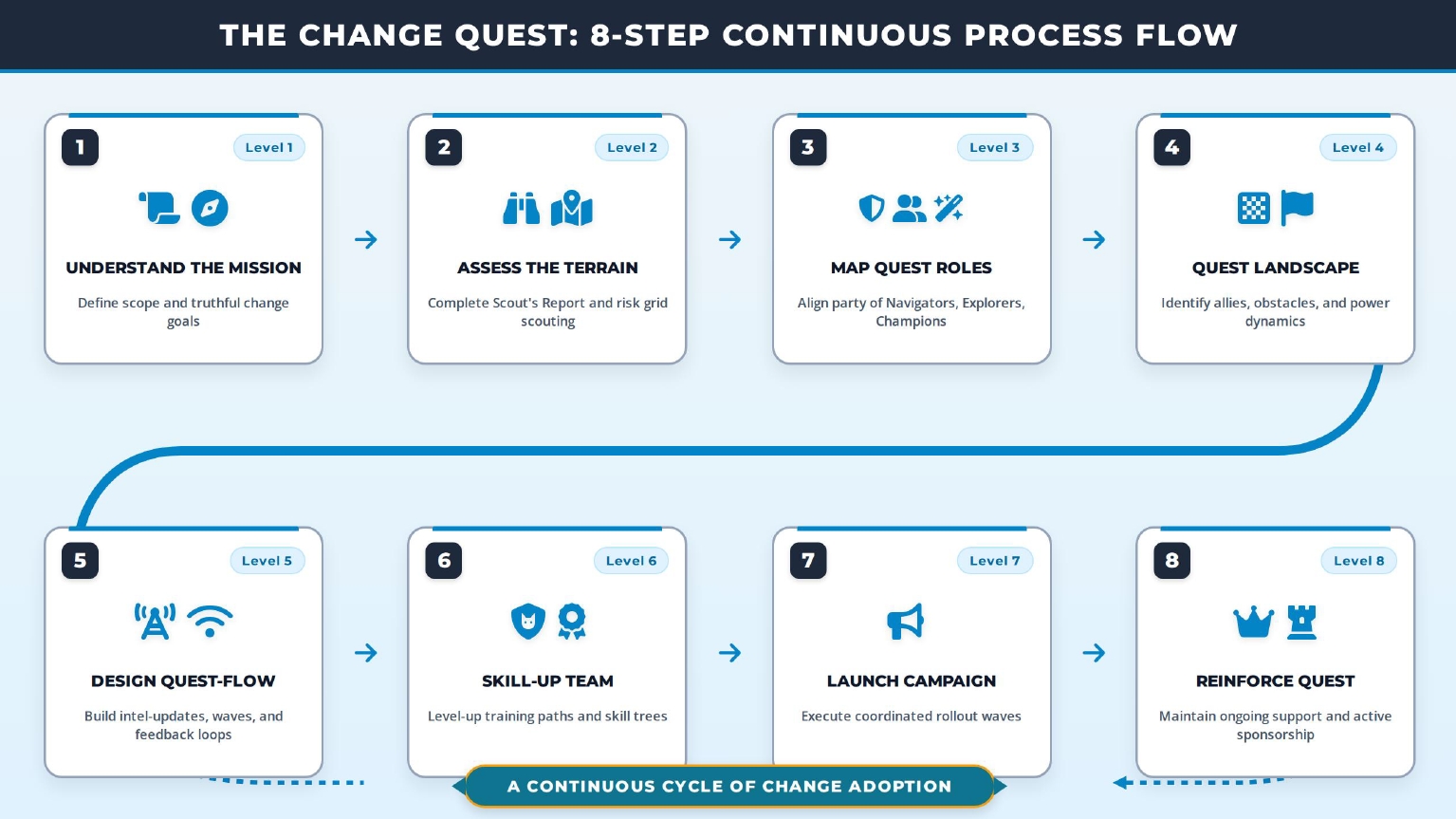
The Change Quest is an eight-step process that gives leaders, teams, and employees a shared map. It helps people understand where they are going, why the journey matters, what role they play, and what support they can expect along the way.
It is also a continuous cycle. We learn as we move. We adjust the plan when needed. We carry those lessons into the next change.
The eight-step journey
The Change Quest begins with a clear purpose and ends by making sure the change lasts.
- Understand the mission
Start with the basics. What is changing? Why is it changing now? Who will be affected? What will success look like? If leaders cannot explain the change clearly, people will fill in the gaps themselves. That can lead to confusion, rumours, and unnecessary worry. - Assess the terrain
Before moving ahead, take an honest look at the organization’s starting point. What changes have happened before? What worked? What did not? What risks, workload pressures, skills gaps, or concerns could make this change harder? A good assessment helps the team see the real conditions, not just the ideal ones. - Map quest roles
Change is not the responsibility of one project team. It needs leaders who set direction, managers who guide their teams, champions who build support, experts who solve problems, and employees who make the new approach work in real life. People need to know their part in the journey. - Understand the quest landscape
Every organization has supporters, critics, informal leaders, competing priorities, and power relationships. Some people will be ready to help. Others may have reasonable concerns. It is better to understand these realities than to pretend they do not exist. - Design the quest flow
Build a practical plan for how the change will happen. This includes communications, training, rollout stages, feedback loops, help for people who need it, and time to make improvements. The best plan is not the most complicated plan. It is the one that people can understand and use. - Skill up the team
Give people the tools, time, training, practice, and support they need to work in a new way. It is not fair to expect people to change if they have not been prepared. Training should be practical and close to the time people need to use the new process, system, or skill. - Launch the campaign
Put the change into action in a planned and coordinated way. Keep people informed. Make help easy to find. Listen to what is happening in teams and on the front line. If something is not working, adjust quickly rather than hoping it will sort itself out. - Reinforce the quest
A launch is not the end of the work. People need continued support, coaching, recognition, and clear leadership until the new way of working becomes normal. The goal is not simply to complete a project. The goal is to make the change stick.
The process is shown as a cycle because change is not a straight line. During rollout, the team may discover that the plan needs to change. Training may show that a process is too complicated. Feedback may point to a risk that was missed at the start.
That is not failure. That is learning.
Lead through personal power
The role of the sponsor matters, but sponsorship is only one part of a successful change effort.
A sponsor must set direction, make decisions, provide resources, remove barriers, and show that the change is important. However, a title alone will not build support for change.
In my article on positional power and personal power, I wrote that the difference is often the difference between compliance and commitment. Positional power comes from a role, title, authority, budget, or reporting relationship. Personal power comes from trust, credibility, relationships, experience, honesty, and respect.[dralanviau]
Positional power still has its place. Leaders must make choices, set priorities, and hold people accountable. But people rarely commit to a change simply because someone senior tells them to do so.
They may comply. They may attend the training, use the new system, or follow the new process because they feel they have no choice. But compliance alone does not mean the change will last.
Personal leadership creates stronger commitment. It means being clear about why the change matters, listening to concerns, recognizing that change may be difficult, and staying involved after the launch. It means showing people, through actions as well as words, that their experience and feedback matter.
The sponsor sets an important tone, but every manager, champion, and team member also has a role in building trust and helping others move forward.
Use language people understand
Change-management professionals often use useful but technical words: stakeholders, readiness, capability building, adoption, deployment, and reinforcement.
These terms may make sense to project teams and change professionals. But they can confuse employees, managers, and others who are being asked to change.
If people do not understand the words, they may not understand the journey.
That is why the Change Quest uses plain language and a simple story. It gives people words they can remember and use.
| Technical language | Change Quest language | What it means |
| Change vision and scope | Understand the mission | Be clear about where we are going and why |
| Readiness assessment | Assess the terrain | Understand what we are dealing with before we begin |
| Stakeholder analysis | Map quest roles | Know who is involved, affected, and able to help |
| Influence and power mapping | Understand the quest landscape | Identify supporters, concerns, obstacles, and informal leaders |
| Change-management plan | Design the quest flow | Plan how people will learn, receive information, and get support |
| Capability building | Skill up the team | Give people what they need to succeed |
| Implementation or deployment | Launch the campaign | Introduce the change in planned stages |
| Reinforcement and adoption | Reinforce the quest | Help the new way of working become normal |
This is not about making change management less serious. It is about making it easier to understand.
Plain language shows respect for people. It makes it easier for a manager to explain the change to a team. It helps champions answer questions. It helps employees see what is expected of them and where they can get help.
For example, instead of saying:
“We will deploy a phased capability-building strategy to support adoption.”
Try saying:
“We will introduce the new process in stages. Each group will get practical training, clear instructions, and help when they need it. We will use what we learn from the first groups to improve the next stage.”
The work behind both statements may be the same. The second statement is simply clearer.
A continuous journey
The final step, Reinforce Quest, is not really the end. It is the beginning of the next round of learning and improvement.
Every change has intended results. It may improve a service, simplify a process, strengthen a team, reduce costs, or help an organization meet a new need.
But every change can also create unintended consequences.
A new process may solve one problem while creating extra work somewhere else. A new digital tool may improve reporting but make frontline tasks harder. A new structure may clarify accountability for some people while creating confusion or delays for others. A communication approach may reach one group well while leaving another group feeling overlooked.
These effects are not always clear at the start. That is why organizations need to keep listening after launch. They need to ask what is working, what is not working, who is benefiting, who may be struggling, and what new problems may have appeared.
Unintended consequences should not automatically be treated as failure. They are part of learning. The important question is whether leaders and teams are willing to see them, discuss them honestly, and make changes when needed.
Every change teaches an organization something:
- What people needed most.
- What leaders did well.
- Where communication was clear or confusing.
- Which training and support methods worked.
- What barriers appeared during the rollout.
- What unintended consequences emerged.
- How the change affected different teams, clients, partners, or communities.
- What should be adjusted now and what can be done better next time.
The Change Quest is not meant to turn change into a simple checklist. Change is rarely simple.
Its purpose is to give leaders, sponsors, managers, and employees a shared map and language they can use together. The process encourages teams to pause, learn from real experience, and adjust the route when the evidence shows that they should.
When people can see the path, understand the reason for change, know their role, and trust the people leading the journey, change becomes less confusing and more achievable.
The real work of change is not forcing people to comply because someone has authority. It is building enough clarity, skill, trust, and commitment that people choose to move forward together—and remain willing to learn as the journey unfolds.


