
I grew up hearing people say “the greatest thing since sliced bread” and I always thought it was a bit of a joke. I had no idea what sliced bread had to do with anything. It just sounded like one of those sayings adults use when they think something is pretty good.
It turns out it is not just a joke. It is actually a short lesson in how fast a useful technology can spread when it solves a simple problem, fits easily into daily life, and rides on an existing system. Sliced bread went from a new idea to an everyday staple in just a few years. It rode on a simple machine, smart packaging, and a partner technology: the toaster.
Today, a similar pattern is showing up with AI agents. These are software tools that can plan, make choices, use other programs, and finish multi-step tasks for you. Like sliced bread, AI agents are built on an existing platform (generative AI) and they solve common, everyday problems. The question is whether they will be the next “thing since sliced bread” in how fast they spread and how much they change daily life.
A short history of sliced bread
Sliced bread was not invented overnight. Otto Frederick Rohwedder, an American engineer and jeweler from Iowa, started working on an automatic bread-slicing machine around 1912. His first model burned down in a fire. He spent more than ten years improving the design until he had a machine that could slice and wrap a loaf reliably.
The big break came in Chillicothe, Missouri. On July 7, 1928, the Chillicothe Baking Company sold the first commercially sliced loaves using Rohwedder’s machine. Local newspapers ran front-page stories. The product was advertised as “the greatest forward step in the baking industry since bread was wrapped.”
Adoption was fast:
- By 1930, Continental Baking Company introduced Wonder Bread as a nationally marketed sliced loaf.
- By 1933, about 80% of bread sold in the United States was pre-sliced, even during the Great Depression.
Sliced bread worked because it:
- Solved a routine problem (cutting even slices).
- Needed almost no change in behaviour.
- Used packaging that helped keep bread fresh.
- Had a partner technology: the pop-up toaster, which worked best with uniform slices.
This mix of convenience, low friction, and ecosystem support made sliced bread one of the fastest-adopted consumer innovations of the early 1900s.
Competing technologies: smartphones and more
Sliced bread is a strong benchmark, but it is not the only fast-adoption story.
Smartphones and app stores
The modern smartphone, especially after the 2007 iPhone launch, created a new platform for software and services. Its adoption was helped by:
- App stores, which offered thousands of specialized tools, games, and services.
- Mobile data networks (3G, 4G), which enabled rich, always-on experiences.
- Falling device prices and improving hardware.
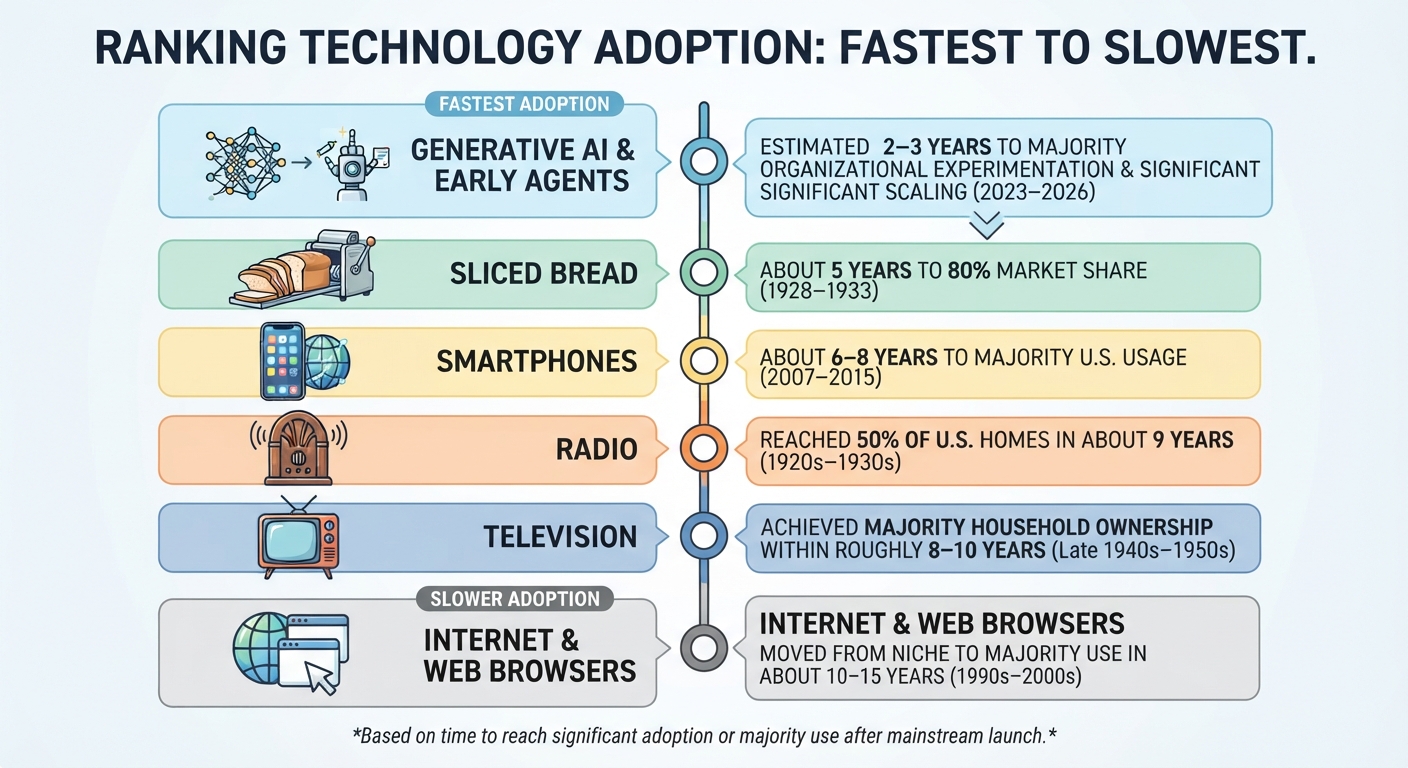
In the United States, smartphone use rose from about 35% in 2011 to 54% in 2013 and roughly 68% by 2015. That is a majority in about 6–8 years from mainstream launch.
Other fast adopters
Historical comparisons often highlight:
- Radio: reached 50% of U.S. homes in about nine years during the 1920s–1930s.
- Television: achieved majority household ownership within roughly 8–10 years after public availability in the late 1940s.
- Internet and web browsers: moved from niche to majority use in about 10–15 years as content and services expanded.
Measured by time to dominance, sliced bread (about five years to 80% of commercial bread) remains one of the fastest, with smartphones and radio close behind.
Enter AI agents
Generative AI tools such as ChatGPT, Gemini, and Copilot showed that machines could produce clear text, code, and images on demand. AI agents take this further: instead of waiting for a prompt, they can:
- Plan a sequence of steps.
- Access approved systems and data.
- Use software tools (email, calendars, CRM, accounting, farm-management systems).
- Complete tasks and report results.
For example, an agent might:
- Monitor inventory and flag low stock.
- Draft and send routine procurement emails.
- Summarize financial variances and prepare briefing notes.
- Coordinate maintenance schedules for equipment.
This shift from assistant to delegate is why agents are attracting intense interest.
Adoption so far
Early data suggest unusually rapid uptake:
- In 2023, roughly one-third of organizations reported regular use of generative AI.
- By 2024, that figure had roughly doubled to around 65–71%, depending on the survey.
- By 2025–2026, many surveys report 80–90% of organizations using AI in at least one function, with a growing share experimenting with or scaling AI agents.
McKinsey’s 2026 survey notes that 40% of large enterprises report scaling AI agents in at least one function, up from 27% the previous year, with software coding agents among the earliest use cases. Other analyses describe a “10–20–70” pattern: a small share of organizations are fully scaling agents, a larger group is piloting, and most are at least experimenting.
What to expect in the next 12 months
Over the next year, agentic AI is likely to move from pilots to practical, everyday use in many offices and organizations.
- Agents inside familiar tools. Expect more agents built into email, office suites, customer-service platforms, and accounting or procurement systems. People will use them through interfaces they already know, which reduces training and resistance.
- More routine tasks automated. Common workflows such as status reports, data reconciliation, customer queries, and basic analysis will increasingly be handled by agents, with humans reviewing and approving the results.
- Clearer rules and controls. Organizations will put in place basic governance: who can use which agents, what data they can access, when human approval is required, and how activity is logged.
- Early role-specific agents. Some teams will start using agents tailored to their work, such as finance agents that monitor spending, operations agents that track equipment, or agricultural agents that combine weather, soil, and crop data to suggest actions.
- Focus on measurable value. Leaders will look for concrete results: time saved, fewer errors, faster cycle times, and better use of staff. Projects that show clear gains will expand; those that do not will stall.
In short, the next 12 months will be less about hype and more about embedding agents into real workflows and proving they deliver value.
Why AI agents could be the next “thing since sliced bread”
If we judge by speed of early adoption, AI agents are a strong contender:
- Sliced bread: about five years to 80% of commercial bread.
- Smartphones: about 6–8 years to majority usage.
- Generative AI and early agents: about 2–3 years to majority organizational experimentation and significant scaling in large enterprises.
AI agents resemble the success of sliced bread because they:
- Solve a frequent, everyday problem. Sliced bread removed the need to cut even slices by hand. AI agents remove the need to manually complete repetitive digital tasks.
- Need little behaviour change. People kept buying bread the same way; they just bought it pre-sliced. Workers keep using email, calendars, and business systems; agents just do more of the steps automatically.
- Ride on an existing platform. Sliced bread used existing bakeries, distribution, and retail. AI agents use existing computers, cloud services, and business software.
- Have a strong partner technology. Sliced bread paired with the toaster. AI agents pair with generative AI models, cloud infrastructure, and enterprise applications.
- Scale through software and process, not heavy hardware. Bakeries retooled machines; organizations reconfigure workflows and permissions rather than buying entirely new systems.
- Become invisible infrastructure. Most people no longer think about sliced bread; it is just “bread.” Over time, agents may become a normal part of software, not a separate product you “adopt.”
AI agents benefit from:
- An existing platform (generative AI).
- Distribution through current software and cloud infrastructure.
- Immediate, visible benefits in routine knowledge work.
- The ability to improve through software updates.
Like sliced bread, they reduce friction in a frequent task. Like smartphones, they create a platform for an ecosystem of specialized capabilities.
The main difference is that agents are still in the early scaling phase. Sliced bread quickly became invisible infrastructure; agents are on a similar path but must still resolve issues of trust, governance, and integration. If they do, they may well earn the title of the latest “thing since sliced bread”—not as a novelty or a joke, but as a quiet, indispensable part of how work gets done.

 Life Horizons