
You’ve defined your clear coordinates of victory (Quest 1: Understand the Mission), returned with the scout’s map of where the terrain is firm or shaky (Quest 2: Assess the Terrain), and assembled your party of Navigators, Explorers, and Champions (Quest 3: Map Your Quest Roles). From there, you mapped out stakeholder dynamics (Quest 4: Understand the Quest Landscape), wired up airtight multiplayer transmission channels (Quest 5: Design the Quest-Flow), and trained your players in sandbox environments to upgrade their stats (Quest 6: Skill-Up the Quest Team).
The strategic prep work is 100% complete. The party is armed, the board is set, and the countdown has reached zero. Now, we enter Quest 7: Launch the Quest Campaign.
In game terms, this is the moment the party sets out on the full journey. But many change leaders fall into a dangerous trap at this stage: treating implementation like flipping a switch.
The Danger of “Flipping the Switch”
Organizations love the idea of “Go-Live Day.” They schedule a single date, assume everyone will adapt simultaneously, and plan to deal with problems as they come up.
Rollout is not an event; it is a campaign. Treating launch as a single, sudden switch introduces massive organizational risk:
- Overwhelming Capacity: Dumping a complex operational or system change on every department at once creates instant gridlock and panic.
- Dead Mics and Bottlenecks: When issues inevitably surface, support desks, managers, and change leads are instantly flooded, leaving frontline teams stranded without help.
- Missed Feedback: Flipping the switch everywhere simultaneously deprives you of early warning signals that could have been fixed in a controlled environment.
- Loss of Momentum: When confusion spreads unchecked, player morale drops, skepticism takes hold, and teams retreat to legacy habits.
Why Phased Implementation Reduces Risk
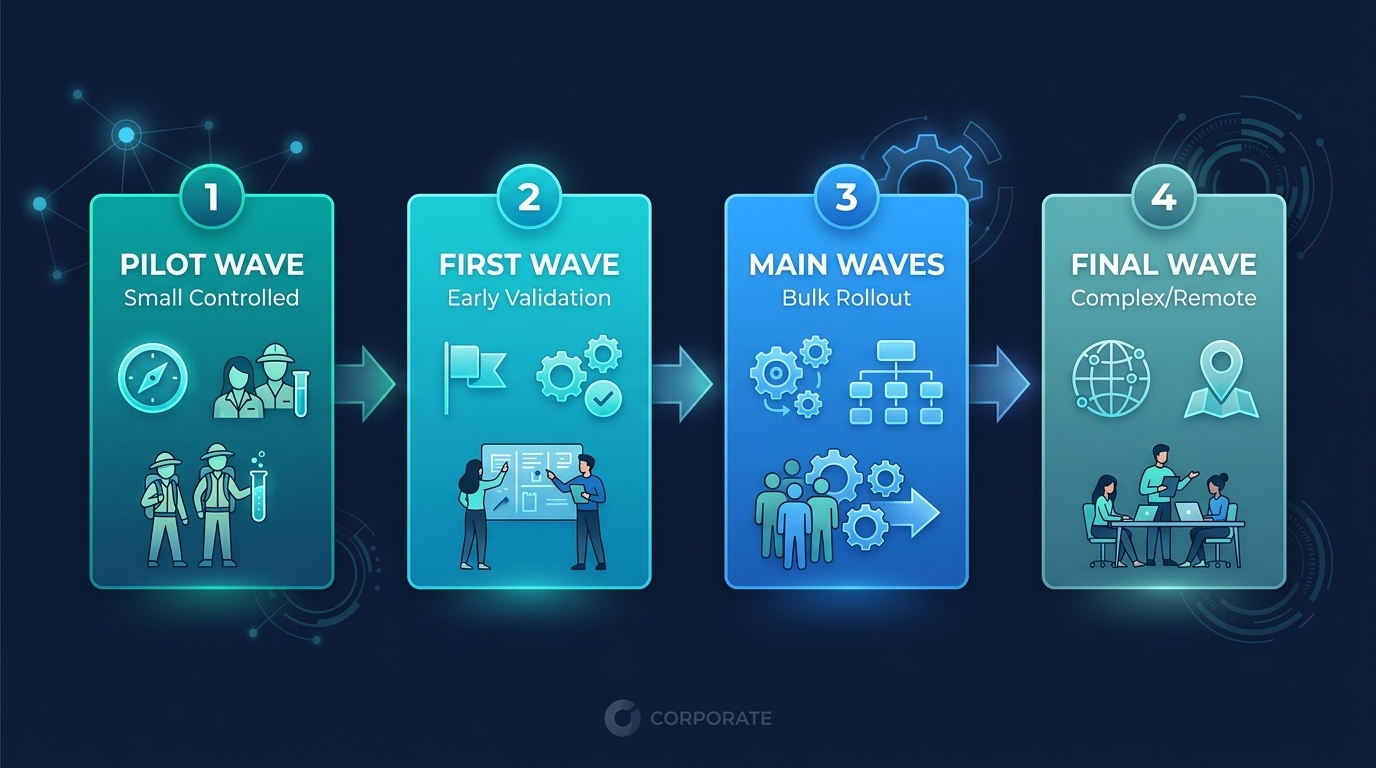
Phased implementation turns launch into a sequence of coordinated campaign waves. By staggering deployment based on your audience analysis, scale, and geographic spread, you dramatically reduce systemic risk.
Early Problem Catching: Running a small Pilot Wave allows you to test system mechanics, validate communication messages, and catch hidden friction before it impacts the broader organization.
- Optimized Support Channels: Staggering rollout waves ensures your support infrastructure—help desks, floor walkers, and local champions—can offer high-touch assistance to each group as they land in the new landscape.
- Building Social Proof: Early wins from initial waves create momentum. When later waves see their peers navigating the new world successfully, resistance drops and adoption accelerates.
What Strong Launch Planning Includes
A successful campaign rollout integrates all the intelligence you gathered in previous quests. Strong launch planning aligns three core elements across every wave:
- Targeted Communication (Quest 5 Insights): Delivering clear pre-launch, go-live, and post-launch intel updates that balance The Loot (benefits) and The Peril (fears) specific to that wave.
- Just-in-Time Capability Refresher (Quest 6 Insights): Ensuring training refreshers, quick-reference guides, and sandbox practice happen immediately prior to a wave going live—not weeks in advance where skills decay.
- Active Feedback & Support Loops: Establishing open Q&A channels, office hours, and real-time telemetry to capture frontline feedback and resolve issues immediately.
Reflection: Launch Pressure and Pacing
The pressure surrounding a launch is real. Executives want rapid results, project management offices (PMOs) chase go-live dates, and project teams are exhausted from months of build-up. In the rush to reach the finish line, it is tempting to rush everyone through the gates at once.
Pacing requires leadership courage. Moving fast is useless if your party stumbles the moment they cross into new territory.
Rollout is a sequence, not a switch. By treating your launch as a deliberate, phased campaign, you respect the human pacing of adoption, protect operational stability, and ensure your team reaches the new landscape united and battle-ready.
👉 Download the full “Change Quest” eBook now to discover step-by-step frameworks for turning change management into an engaging, quest-driven success.


