
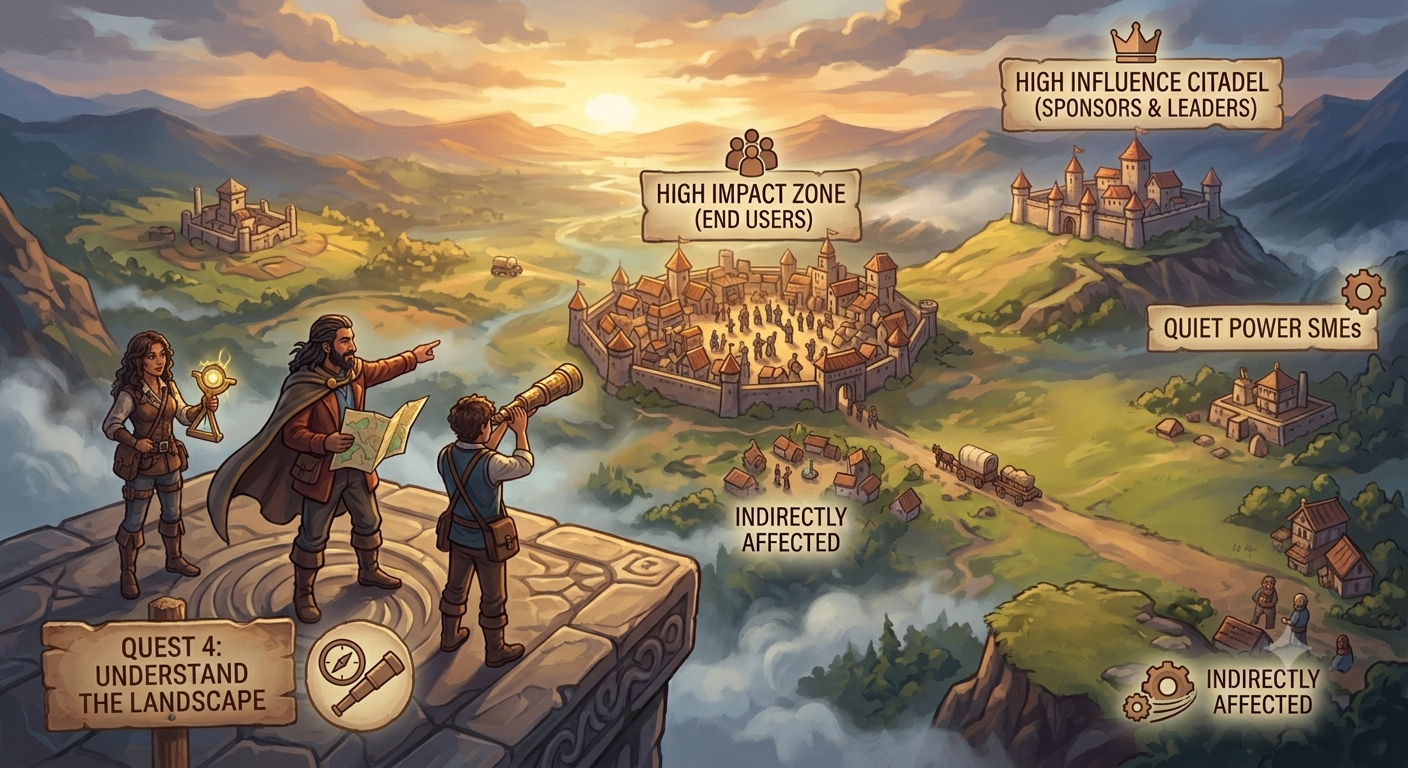
Once the party is built, the next question is simple: How do the people in it relate to the change?
That is Quest 4, and it is where stakeholder mapping becomes infinitely more useful than stakeholder counting.
It is not enough to simply know who is involved. You need to know how each person is positioned in relation to the change, what they care about, how deeply they are affected, and what they can contribute.
That understanding makes the ultimate difference between generic corporate noise and targeted, high-impact support.
Why the Landscape Matters
In quest language, the landscape isn’t just the map on the wall; it’s the shape of the terrain surrounding every person on the journey.
Some people carry immense influence. Some hold deep interest. Some will feel the heavy day-to-day impact. Others sit on the periphery yet possess the hidden power to quietly accelerate or derail the entire mission.
If you treat everyone the same, you waste energy where it isn’t needed and starve support where it is essential. That is why one-size-fits-all engagement fails every single time.
The Four Dimensions of the Landscape
A truly useful landscape assessment looks beyond simple job titles and asks four fundamental questions:
- Influence: How much structural or informal authority does this person or group have over the project’s outcome?
- Interest: How closely are they watching this initiative, and how much do they personally care about its success or failure?
- Impact: How drastically will their day-to-day routines, tools, or responsibilities change?
- Contribution: What unique expertise, advocacy, or operational capacity can they bring to the journey?
These dimensions prevent the common executive trap of assuming that the most visible leaders are the only people who matter.
Broadcast Thinking vs. Strategic Engagement
One-size-fits-all engagement usually fails because it relies on broadcast thinking: sending the exact same broadcast message to every inbox in the company.
Stakeholders do not need the same message, the same detail, or the same involvement:
- Senior Sponsors need strategic alignment, risk escalation paths, and decision metrics.
- Front-line Supervisors need operational timeline clarity, mitigation strategies, and coaching tools.
- Highly Impacted End Users need empathetic support, practical training, and clear answers to “What changes for me on Monday morning?”
- Adjacent Teams need to know where system handoffs or workflow boundaries will shift.
If you send the same generic broadcast to everyone, leadership gets bogged down in tactical noise, front-line teams get abstract jargon, and critical risk signals get lost in the shuffle.
Prioritizing Energy Where It Counts
Once the landscape is clear, you stop spraying and praying. You deploy energy surgically:
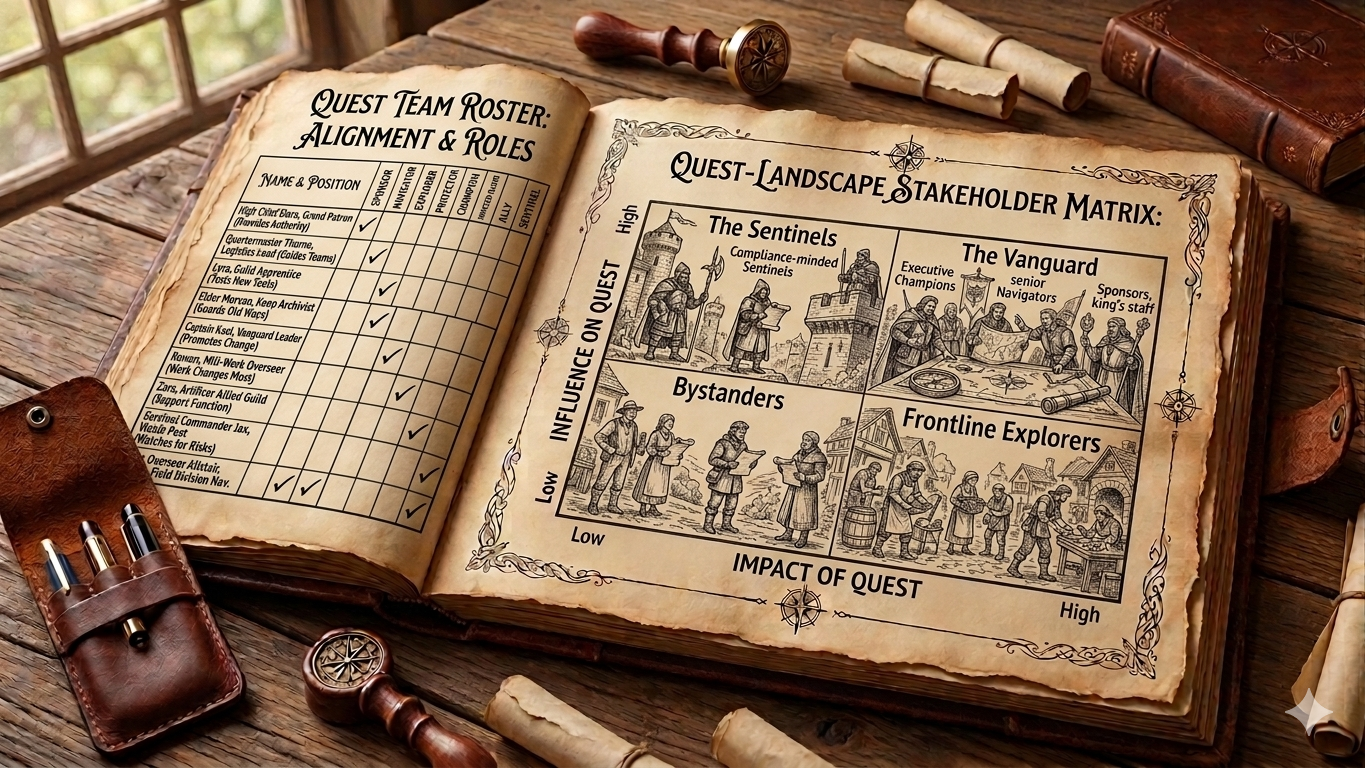
- High Impact / High Interest: These are your front-line champions or primary training targets. They need early engagement and robust support.
- High Influence / Low Interest: These are your potential wildcards. They require direct sponsor conversations to ensure their passive indifference doesn’t turn into active friction.
- Low Influence / High Impact: These are often your quiet operational experts. Giving them a platform to shape training and workflow design builds trust and prevents costly rework.
The goal isn’t to give everyone the exact same slice of your time—it’s to give each group precisely what they need to move forward safely.
A Real Project Lesson: The View from the Field
On one major transition, the initial change picture looked completely bulletproof on paper. The project team had ticked every traditional box: technical architecture was solid, executive governance was aligned, and headquarters management was fully briefed.
When we stepped back to examine the actual human landscape, a massive gap emerged: the field operators.
These were the teams outside the main office who would have to execute the new process in real time under harsh daily conditions. They hadn’t been included in the initial feedback loop because they didn’t sit at the main decision table. Yet, they were the ones who would carry 90% of the operational burden.
Because we caught this through a terrain and landscape assessment, we immediately pivoted our engagement model—bringing field leads directly into the testing and feedback loops. Without that correction, the project would have looked like a massive success in executive slide decks, but an absolute failure on the ground.
The landscape always reveals where the real work lives.
The Path Forward
Quest 4 transforms a static contact list into a dynamic, human-centered strategy. It eliminates broad assumptions, prevents wasted budget, and ensures your communication and training land where they are needed most.
Once the landscape is clear and your people are properly understood, you are ready for the next critical step: designing the continuous flow of communication that carries the mission forward.
That is Quest 5: Design the Quest-Flow.
Ready to map your landscape?
Stop broadcasting and start strategizing. Understanding how influence, interest, and impact intersect is the key to driving real organizational adoption.
Download the complete Change Quest framework e-book for free to access our full Stakeholder Landscape Matrix and engagement planning templates.
👉 [Download the free Change Quest e-book here]
When mapping out a major organizational change, how do you handle stakeholders who possess high informal influence but low interest in the new direction? Let’s discuss in the comments below!
#ChangeManagement #Leadership #BusinessTransformation #ChangeQuest #StakeholderMapping #OrganizationalChange


