
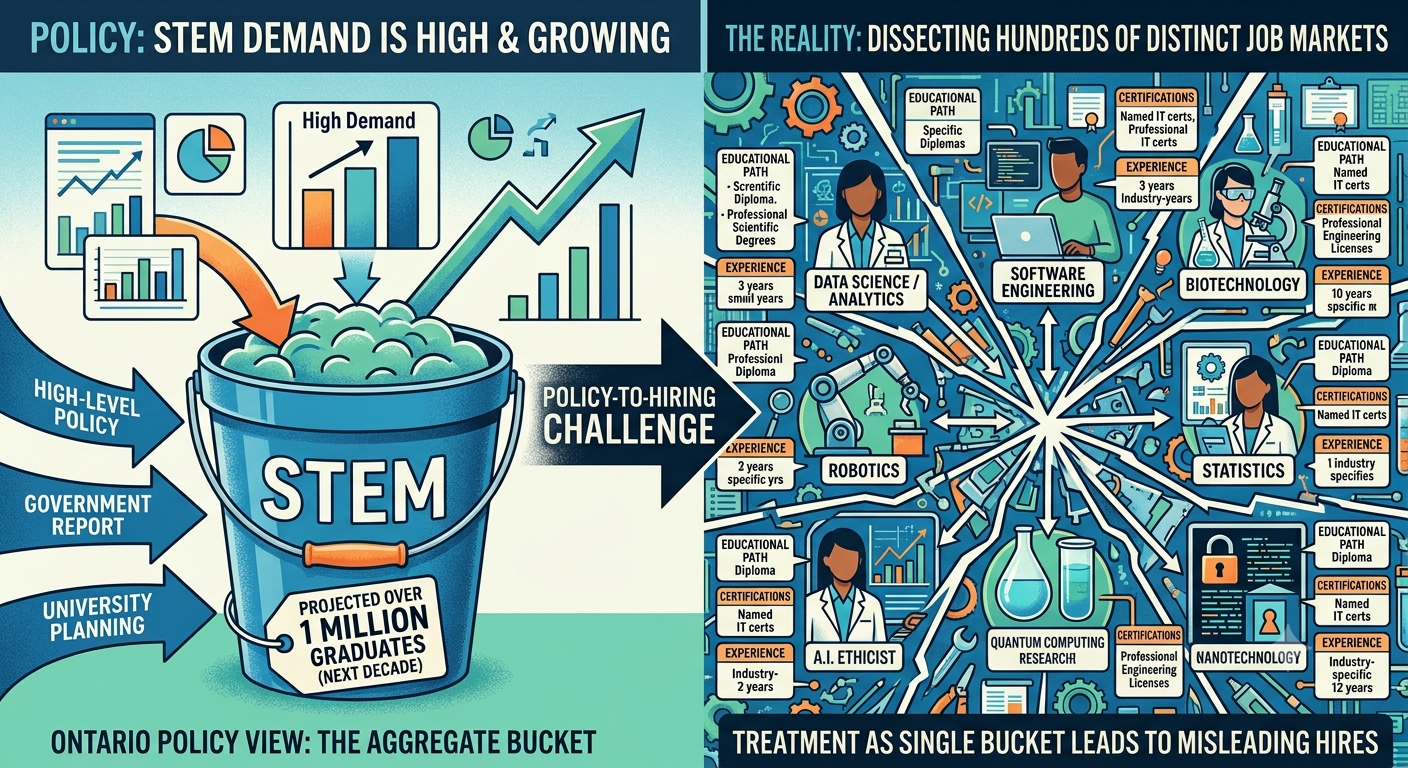
A recent report on Ontario’s labour market projects that the province will need over one million university graduates over the next decade. The biggest surge in demand? STEM, followed closely by health sciences and finance.
That headline sounds straightforward enough. But broad labour-market categories hide a much messier reality.
STEM is not one single job market. It is hundreds of distinct professions—each with its own educational path, certifications, experience profile, and workplace context. Treating “STEM” as a single bucket may be convenient for high-level policy, but it becomes misleading when employers, universities, and governments try to translate that bucket into actual hiring.
The Myth of the Generic STEM Worker
The acronym suggests a unified workforce, but the job market doesn’t work that way. A software developer, a civil engineer, an environmental scientist, a project manager, and a lab technologist all sit under the STEM umbrella—yet their daily work and necessary skills couldn’t be more different. Even within a single discipline, two job ads can demand entirely incompatible tools and credentials.
This is why the aggregate “STEM shortage” narrative oversimplifies the challenge. Employers aren’t looking for a “STEM graduate” in the abstract. They are looking for a hyper-specific combination of technical knowledge, sector experience, certifications, soft skills, and local work history.
In practice, many of these roles aren’t standard vacancies—they are unicorns.
       POLICYSPEAK                    REALITY
┌───────────────────────┐    ┌───────────────────────┐
│                       │    │ • Civil Engineer      │
│     "STEM DEMAND"     │ ═> │ • Data Analyst        │
│    (1 Million Jobs)   │    │ • Lab Technologist    │
│                       │    │ • Software Developer  │
└───────────────────────┘    └───────────────────────┘
When Job Postings Become Wish Lists
Anyone scanning job boards can see where the system breaks down. Employers frequently ask for project management, change management, industry-specific expertise, bilingualism, and niche technical skills—all in one mid-level posting. The candidate pool shrinks to near zero before the first interview even happens.
This is where policy analysis loses touch with practical recruitment. A report says Ontario needs STEM graduates, but an employer is actually searching for someone who has already done the exact same job, in the exact same environment, with zero learning curve.
That isn’t a hiring strategy; it’s a wish list.
What Procurement Teaches Us About Recruitment
In public procurement, a long list of rigid, non-negotiable requirements usually leads to a failed bidding process, not a better product. Recruitment suffers from the exact same flaw. When every qualification is treated as mandatory, hiring stops being a search for talent and becomes a filter for perfection.
Employers need to treat hiring more like a smart procurement process:
- Define true must-haves: Keep the absolute requirements minimal.
- Use a rating scale for the rest: Evaluate adaptability, problem-solving, and potential.
- Hire for capacity: Accept that candidates will need on-the-job training.
I experienced this firsthand early in my career at Hewlett-Packard. On paper, I didn’t meet every single requirement for the role. But HP didn’t expect a fully pre-packaged worker. What mattered was their assessment that I had the foundational capacity to learn, contribute, and grow.
That kind of employer commitment built real careers. Today, too many organizations expect talent to arrive pre-assembled on day one.
Key Takeaway: Universities build foundational capability—analysis, technical fundamentals, and problem-solving. They cannot predict every hyper-specific job description an employer invents.
Training Is Part of the Deal
The modern labour market has grown overly transactional. Employers want finished products without investing in development. At the same time, universities are judged on whether their graduates can perform niche, hyper-specific tasks from their first hour on the job.
That expectation is broken. A healthier model splits the responsibility fairly:
| Role | Core Responsibility |
| Universities | Provide strong foundational skills, work-integrated learning, and clear career pathways. |
| Employers | Write realistic job descriptions, hire for potential, and invest in mentorship and training. |
A Better Way Forward
Ontario’s talent challenge won’t be solved simply by pumping out “more graduates.” It requires a realistic alignment between education and employment.
If Ontario wants to build a resilient workforce, we cannot keep pretending that a single umbrella term like STEM describes a single labour market. The real economy is made up of thousands of unique roles, each with its own logic.
The future won’t be built by statistical aggregates. It will be built by people—trained well, hired wisely, and given room to grow.


