
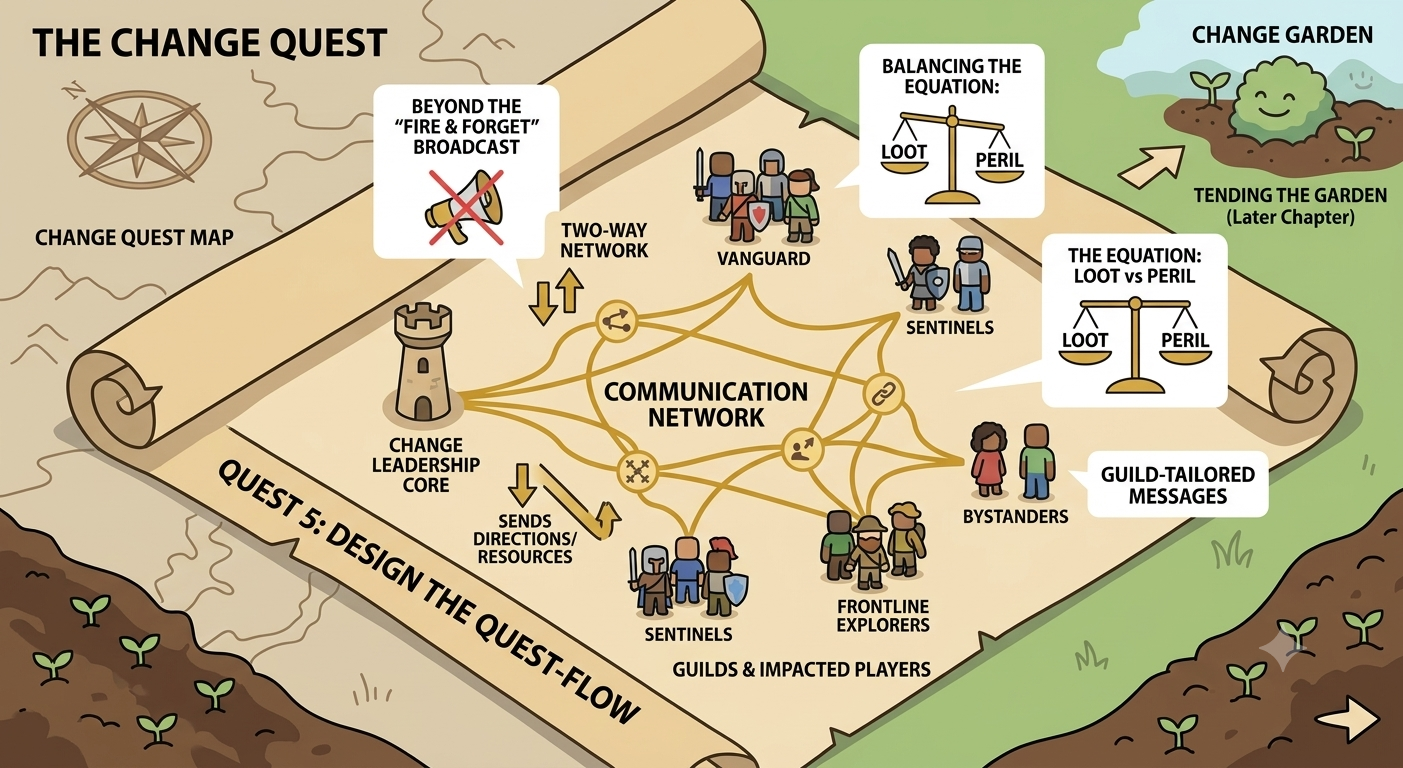
Communication is not an administrative side activity in organizational change—it is the living root network of your team’s ecosystem. Just as a forest relies on interconnected roots to share water, send warning signals, and nourish young trees, an effective quest-flow keeps every guild connected to the same ground. When communication is treated as a static, top-down announcement, the network breaks. Teams are left isolated, under-resourced, and unprepared for unexpected shifts in the landscape.
(We will build on this idea of cultivating and managing your organization like a living Change Garden in later chapters.)
Beyond the “Fire and Forget” Broadcast
The old way of managing projects assumes leadership can simply post an announcement, walk away, and expect the environment to change on its own. Healthy team communication works like a living network: players receive signals, test them out, adapt, and send feedback back up the chain. That feedback isn’t noise—it is vital information from the front lines.
One-way broadcasts usually fail because they treat active team members like passive observers rather than key players. They tend to break down in three ways:
- Lacks Meaning: It explains what process is changing but misses why it matters to the individual doing the work.
- Poor Timing: It sends information long after critical choices have already been locked in.
- Ignores Daily Reality: It overlooks hidden obstacles, heavy workloads, and daily friction that prevent a new habit from taking root.
An announcement can be clearly written and still fail if there is no path for information to flow back and forth.
Constructing a Two-Way Network
A resilient Quest-Flow relies on an active two-way street. The leadership core sends out clear direction and resources, while actively listening for updates and warnings coming back from the field.
- If teams misunderstand the goal: Simplify the message and clear out unnecessary clutter.
- If a guild spots a hidden risk: The entire team adjusts its plan before damage can spread.
- If different groups need different details: Adjust the depth—give high-level strategy to decision-makers and practical, step-by-step guidance to frontline workers.
Communication isn’t just about sending messages; it’s about keeping the whole team aligned and supported in real time.
Balancing the Equation: Loot vs. Peril
Every message traveling through your Quest-Flow needs to balance two main factors: The Loot (the rewards) and The Peril (the risks and challenges).
| Message Type | Focus Area | Player Perspective |
| The Loot | Saved time, better tools, smoother routines, new skills. | “How does making this shift make my daily work easier or better?” |
| The Peril | Extra workload, learning curves, temporary disruption, lost comfort. | “What extra effort will this take, and where will things get messy?” |
Key Rule: If your Quest-Flow only promises great results (“The Loot”) while ignoring the hard work (“The Peril”), people will dismiss it as corporate hype. Honest communication addresses challenges directly while showing how working through the change leaves everyone better off.
Guild-Tailored Messages
Using the map created in earlier quests, your communication needs to be tuned for different groups across the organization:
- The Vanguard (High Influence / High Impact): Clear, direct tactical briefings focused on main goals, key dates, and managing major risks.
- The Sentinels (High Influence / Low Impact): Targeted updates showing that safety, security, and core operations remain solid and reliable.
- The Frontline Explorers (Low Influence / High Impact): Hands-on practice sessions and open Q&As focused on making daily tasks easier.
- The Bystanders (Low Influence / Low Impact): Quick background updates—like progress bars on a dashboard—to keep them informed without cluttering their focus.
Dropping Bad Communication Habits
Many project failures are just communication breakdowns in disguise. Common habits that block your Quest-Flow include:
- Information Overload: Dumping long, complex manuals on teams all at once.
- Corporate Jargon: Using vague buzzwords that sound fancy but offer zero practical guidance.
- One-Way Talking: Speaking at people instead of having an actual conversation with them.
- The Single-Email Trap: Assuming that sending one company-wide email means the message was fully understood.
- Confusing News with Action: Mistaking the delivery of a message for real understanding and updated habits.
Summary
The real power of Quest 5 goes beyond writing emails or making presentation slides. It is about building a reliable network—a connected system that carries clear information in both directions, alerts leadership to unexpected problems, and lets the entire team adapt together. Good communication doesn’t just announce the plan—it gives people what they need to complete the journey.
Download the full e-book here: Book

 Life Horizons