
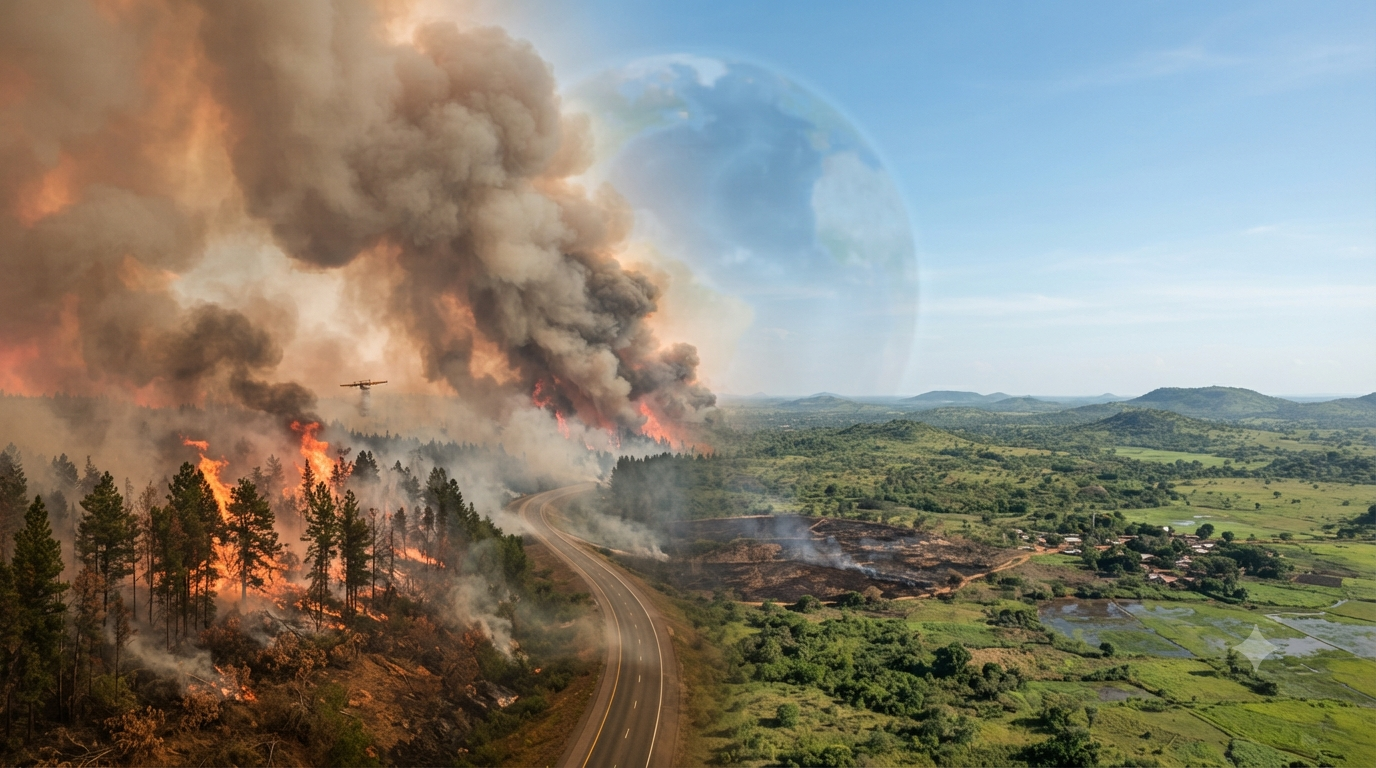
Mention climate change and wildfires in the same sentence, and most people picture a single, apocalyptic future: a world simply going up in flames. But the reality unfolding across the globe is far more complex, and far more revealing. Climate change isn’t writing a simple narrative of “more fire everywhere.” It is writing two entirely different fire stories at the exact same time.
Look at Canada, where human-induced warming acts as a relentless multiplier. Hotter summers and prolonged droughts are baking boreal forests into tinderboxes, lengthening fire seasons and turning routine weather events into historic crises. By mid-summer, it is now common to see hundreds of active wildfires burning nationwide—ranging anywhere from 800 to over 1,000 blazes—with dozens classified as out of control.
Now look across the globe to parts of Africa, where the signal flips. Shifting rainfall patterns are causing rains to arrive later at the start of the dry season. Vegetation stays wetter for longer, shortening the burning window and actually reducing the total area burned in those regions.
This contrast matters. It proves that climate change isn’t a uniform volume knob being turned up across the globe. Instead, it is a complex recalculation of local moisture, temperature, fuel dryness, and seasonal timing.
For Canada, the lesson of this dual reality is blunt: wildfire can no longer be treated as a rare, passing emergency. It has become a permanent feature of our operating environment.
When a single hot stretch can transform a quiet summer into a multi-province crisis overnight, wildfire stops being just an environmental issue. It becomes a systemic challenge that reshapes every layer of civil society—dictating public health through hazardous air quality, threatening housing and municipal infrastructure, spiking insurance rates, and straining supply chains to their limits.
This is where public leadership can draw direct, invaluable lessons from the formal discipline of change management.
Change management exists to help organizations navigate radical, structural shifts rather than reacting to daily surprises. To adapt to an escalating climate reality, governments and institutions can apply those same core change principles to public resilience:
- Shift from “Unfreeze–Change–Refreeze” to Continuous Adaptation: Traditional emergency management treats a crisis as a temporary disruption—you respond, recover, and return to “normal.” Change management teaches that in volatile environments, there is no stable “after.” Leaders must build flexible policies—such as dynamic building codes and adaptive urban planning—that update continuously based on real-time climate signals rather than waiting for static multi-year reviews.
- Treat Risk Assessment as an Operational Input, Not an Anomaly: Organizational change fails when new risks are treated as special exceptions. Infrastructure design, healthcare resource planning, and grid management must treat multi-province smoke events and sudden wildfire surges as standard operating inputs. When severe fire seasons are built into baseline budget models, institutions stop being caught off guard when the inevitable occurs.
- Establish Borderless Governance Across Jurisdictions: Wildfires do not respect provincial lines, crown land limits, or treaty borders, yet response capabilities are often hampered by jurisdictional silos. Applying structural change management means collapsing these barriers—building unified command protocols, shared real-time data networks, and co-governing response bodies that give First Nations leadership, provincial agencies, and federal resources equal operational agility.
- Master Strategic Triage (Remote vs. Community Protection): Suppressing every blaze across 300 million hectares of boreal forest is physically impossible and ecologically unsound. Change management forces clear, objective resource prioritization: focusing intensive suppression on the Wildland-Urban Interface to protect lives, homes, and critical corridors, while relying on satellite tracking, prescribed burns, and air-quality preparedness for deep-wilderness fires.
Africa’s changing fire dynamics show us that climate change alters the timing of environmental risk as much as its scale. Canada’s experience proves that when those risks peak, our window to react shrinks to almost nothing.
A stronger, more resilient future will not come from hoping for a milder summer or relying on luck. It will come from reading these climate signals correctly, treating continuous adaptation as normal governance, and building institutions agile enough to match the reality on the ground. The fire landscape has changed—it is time for our leadership to change with it.

 Life Horizons