
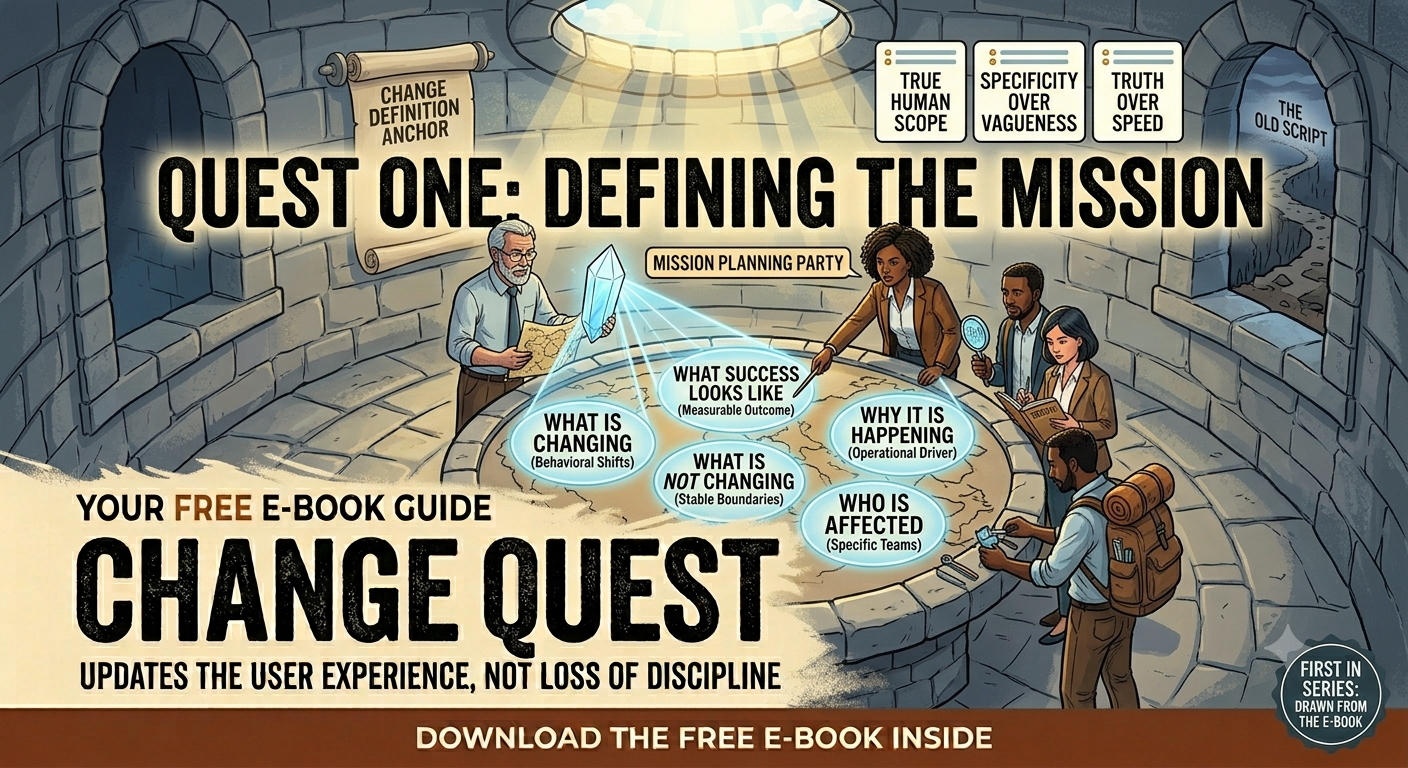
Before you can manage change, you must define it.
That sounds entirely obvious, but it is one of the most common places where organizational change efforts completely derail. Too often, leaders launch an initiative with a project name, a timeline, or a software solution, and assume that is enough. It is not. If the change itself is not clearly defined, every single step that follows is built on a foundation of deep uncertainty.
That is why “Quest 1: The Mission Briefing” comes first in the framework. Before you run a risk analysis, before you map your stakeholders, and long before you design a single training deck, there must be a mission briefing. This is the precise moment when the change is named honestly, specifically, and in terms the workforce can understand.
Why Definition Must Come First
Many change efforts start by asking the wrong questions. They ask, “What is the project?” or “What is the technical deliverable?” when they should be asking, “What is changing in the way our people work?”
That difference is everything.
A project can be about installing a new mobile financial tool, but the real change involves new workflows, new approvals, altered responsibilities, and entirely new day-to-day expectations. A policy update may sound purely administrative on paper, but the actual change profoundly impacts accountability and decision-making authority.
If you only describe the technical side, you completely miss the human side. And if you miss the human side, the change will never be ready for the terrain it is about to enter.
What Counts as a Real Change Definition?
A real change definition goes far beyond corporate labels and vague jargon. At an absolute minimum, it must clearly articulate five core elements:
- What is changing – The specific operational and behavioral shifts.
- What is NOT changing – The stable boundaries people can rely on for certainty.
- Who is affected – The precise groups whose daily routines will be altered.
- Why it is happening – The genuine business or operational driver behind the move.
- What success looks like – The tangible outcome once the destination is reached.
Without these elements, the change remains too vague to guide action. If your people cannot tell what is shifting, they cannot calculate what it means for them. Furthermore, if your leaders cannot explain the change clearly, they will be utterly incapable of assessing its impact accurately.
The Language Test: If you can only describe the change using the technical language of the project team, it is not defined well enough yet.
The High Cost of Vague Scope
Scope clarity is not a bureaucratic nice-to-have; it is the anchor for the rest of your planning.
If you define a change too narrowly, you will wildly underestimate the work required. If you define it too broadly, you will scatter your focus. Either way, your risk analysis becomes distorted. You may end up preparing for a minor technical adjustment when the workforce is facing a massive shift in behavior, workload, or authority. Conversely, you might overcomplicate a small, contained change and trigger unnecessary anxiety and resistance.
Quest 1 is not about speed—it is about “truth”. The clearer the scope, the better your judgment will be as you take the next steps of the quest.
- INSUFFICIENT SCOPE: “We are upgrading the system.”
- THE MISSION BRIEFING: “We are changing how decisions are made, who holds approval authority, and how our field teams access data.”
A Real-World Lesson in False Confidence
One of the most critical lessons I have learned across decades of transitions is that vague change descriptions create a dangerous illusion of false confidence.
I once witnessed an initiative described in exceptionally narrow terms—almost as if the wording had been deliberately chosen to minimize disruption. On paper, it looked like a simple system update. In practice, it fundamentally altered how people worked, how decisions were made, and who had to adapt the most.
Because the initial definition was far too narrow, the organizational impact was completely underestimated. By the time the real behavioral effects became visible, the workforce was already miles behind. Vague language masks the actual weight of a transition, leaving an organization entirely unprepared. The inevitable result is shock, confusion, and avoidable resistance.
The Mission Briefing Mindset
Quest 1 asks change leaders to do something counterintuitive: slow down long enough to see the change clearly before acting on it.
It requires asking and answering the grounding questions that determine whether the rest of the journey stays connected to reality:
- What part of the daily work will feel different?
- Who will experience that difference most directly?
- What is staying the same?
A good mission briefing doesn’t solve the entire change on day one. It does something far more valuable: it gives the change a definite, unmistakable shape. And once you know the true shape of your mission, you can assess the terrain, build your party, and design the rest of the journey with absolute confidence.
Ready to properly brief your next mission?
This post marks the official first step in our exploration of the 8-step Change Quest framework. Over the coming weeks, we will move from the mission briefing straight into assessing the hidden risks of the organizational terrain.
You can download the complete Change Quest framework and e-book for free directly within this series to get the full toolsets for each step.
[Download the free Change Quest e-book here]
In your experience, what is the biggest risk when a project’s true human scope is hidden behind a technical title? Let’s discuss in the comments.


