
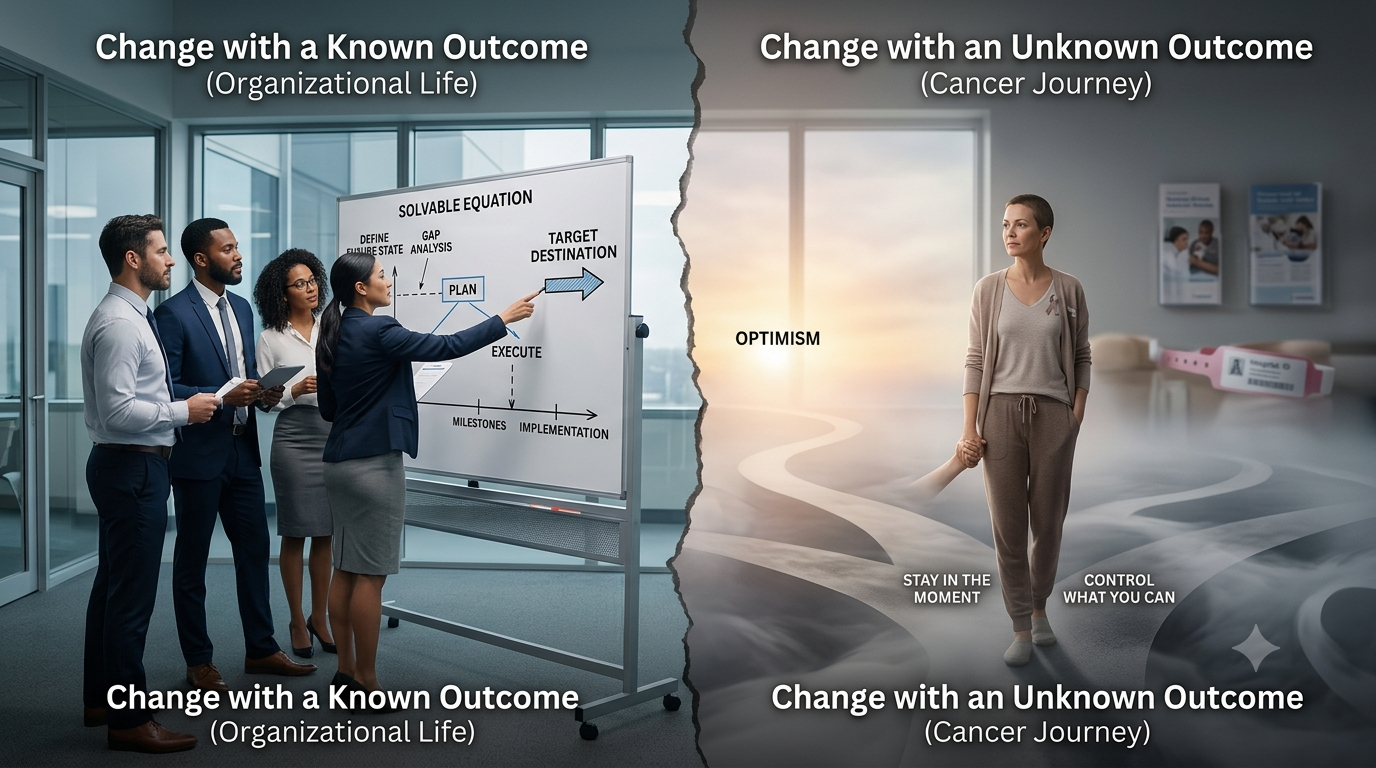
In organizational life, we tend to treat change as a solvable equation. Define the future state, map the gap, build a plan, and guide people through it. This is the foundation of most change management frameworks, from Prosci to APMG: clarity of outcome enables structured transition.
But not all change works that way.
Some of the most consequential changes we face—serious illness, personal crisis, economic shocks—arrive without a defined endpoint. There is no clear “future state,” no guaranteed timeline, and no assurance of success. These are not implementation challenges. They are navigation challenges.
Understanding the difference between these two types of change is not just theoretical—it fundamentally alters how we lead, decide, and cope.
Change with a Known Outcome: Managing the Transition
In organizations, change is usually anchored in a defined goal: a new system, a revised process, a restructuring, or a strategic shift. The destination is known, even if the journey is complex.
This allows for a structured approach:
- Define the future state clearly.
- Assess impacts and readiness.
- Build communication and training plans.
- Measure progress against milestones.
The psychological contract here is also clearer. People may resist, but they understand that there is a destination. The role of leadership is to reduce uncertainty, align stakeholders, and maintain momentum toward a known end.
In this context, overthinking is often productive. Analysis reduces risk. Planning creates confidence. Control is both possible and expected.
Change with an Unknown Outcome: Lessons from My Cancer Journey
My perspective on uncertainty is not theoretical. I was diagnosed simultaneously with three unrelated cancers, and in each case, I did not know how the story would end.
There was no clear path, no defined outcome, and no reliable way to predict what would happen next. As someone trained to analyze, plan, and solve problems, my instinct was to think it through—to model scenarios, anticipate outcomes, probabilities, and try to regain a sense of control.
That approach quickly ran into a wall.
Overthinking did not produce clarity. It led to a mental spiral—what I would describe as a “rathole of despair,” where each line of reasoning opened more uncertainty rather than less.
What emerged instead were hard-earned lessons that became practical rules for navigating the unknown:
- Stay in the moment. The future was too uncertain to carry mentally. Focusing on the day, the appointment, the next step made it manageable.
- Control what I could. Treatment choices, nutrition, rest, mindset—these were within my influence, even when outcomes were not.
- Let go of what I could not control. Test results, timelines, and long-term prognosis had to be released, not solved.
- Remain open to options. New information, alternative approaches, and unexpected possibilities often appeared—but only if I stayed receptive.
- Choose optimism deliberately. Not as denial, but as a way to keep moving forward.
This last point proved essential. Optimism, I found, is not about ignoring reality—it is about maintaining the capacity to act within it. Research supports this: an optimistic mindset broadens thinking, improves resilience, and increases the ability to navigate uncertainty effectively.
In a situation where outcomes are unknown, optimism becomes a form of discipline.
Leadership in the Unknown: A Broader Application
These same principles are now visible at the leadership level in times of broader uncertainty. When facing economic or geopolitical instability, leaders such as Prime Minister Mark Carney emphasize controlling what is possible, staying flexible, and actively seeking alternatives in an unpredictable environment.
This is a different kind of leadership.
It is less about executing a predefined plan and more about maintaining direction without certainty. It requires:
- Stabilizing what can be controlled.
- Creating options rather than fixed paths.
- Communicating honestly about uncertainty.
- Sustaining confidence without promising specific outcomes.
This is not traditional change management. It is navigation under uncertainty.
Bridging the Two Worlds
For those of us trained in structured change management, the instinct is to impose order on every situation. But one of the most important distinctions I have learned—professionally and personally—is that not all change should be managed the same way.
- When the outcome is known, plan, structure, and execute.
- When the outcome is unknown, focus, adapt, and endure.
Confusing the two creates problems. Trying to “solve” an unknowable future can lead to paralysis or despair. Failing to structure a known change can lead to drift and failure.
The skill lies in recognizing which type of change you are facing.
A Final Reflection
Going through cancer reshaped how I understand change at a fundamental level. It forced me to confront uncertainty not as a temporary inconvenience, but as a condition to be managed.
Living in the moment became practical, not philosophical. Letting go became necessary, not optional. And optimism became a deliberate, daily choice.
Those lessons now inform not just how I approach personal challenges, but how I think about leadership, resilience, and change itself.
Because sometimes the most important shift is not the change we are managing—but the mindset we bring to it.


