
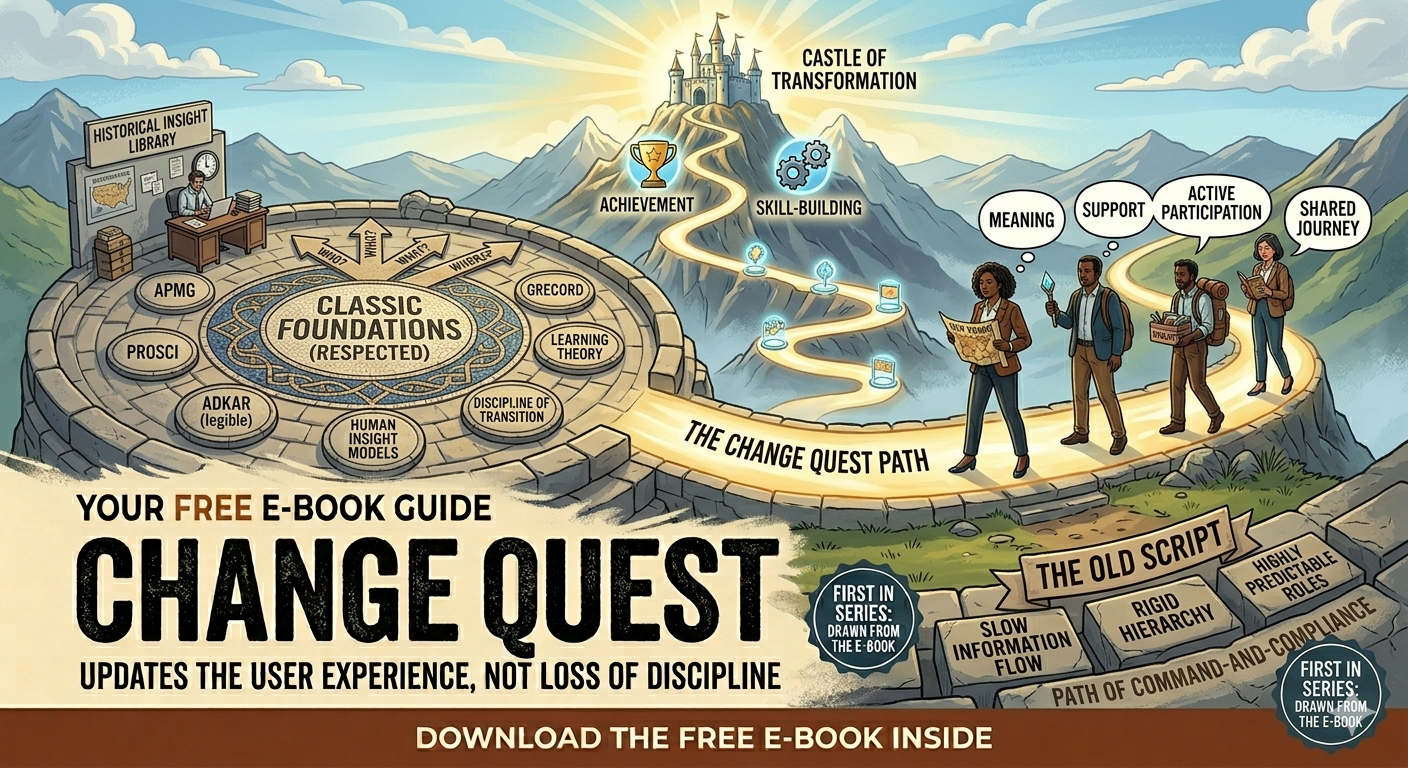
The story can change, but the foundations still matter.
That is the balance I want to maintain throughout this series. In the first two posts, we explored why change needs a better story and why the old script no longer fits the modern workforce. But challenging the script does not mean we should discard the models that got us here in the first place.
The classics still matter because they accurately explain how human beings actually move through transition.
Frameworks from APMG, Prosci, and established learning theory are not outdated just because our corporate vocabulary needs to evolve. They still provide the structure, the discipline, and the deep human insight that make change work. If anything, they matter more now because organizations are moving faster, people are under unprecedented pressure, and the human side of change is simply too big to ignore.
Why the Classics Endure
Classic change models endure for a reason: they force us to ask the right questions before we rush into action. They ground us in reality by demanding answers to critical human questions:
- Who is deeply affected by this shift?
- What is truly changing in their day-to-day reality?
- What specific support is required to bridge the gap?
- Where might resistance naturally appear, and why?
- What actually happens after the go-live date?
These questions keep change initiatives grounded. They serve as a constant reminder that change is never just a sequence of technical tasks. It is a profound shift in behavior, confidence, capability, and reinforcement.
Different frameworks excel at highlighting different pieces of this puzzle:
- APMG helps us master structure, stakeholder awareness, and real benefit realization.
- Prosci (ADKAR) masterfully maps the individual human journey through Awareness, Desire, Knowledge, Ability, and Reinforcement.
- Learning Theory reminds us that people never learn simply by being told once. True adoption happens through an iterative cycle of doing, reflecting, and applying.
The True Balance of Change
One of the clearest ways to visualize why these classic principles remain unshakeable is by looking at the true balance of where change effort must be spent.
Think of it as a clear hierarchy of real-world impact:
- 70% PEOPLE, CULTURE, & BEHAVIOR- The messy human reality of shifting daily habits.
- 20% SYSTEMS, TOOLS, & PROCESSES- The actual technical and procedural changes being made.
- 10% STRUCTURE & GOVERNANCE- The formal project plans, timelines, and steering committees.
In plain language, most of the work in any change initiative goes into people, culture, and behavior. A smaller portion goes into the systems and tools themselves, and the smallest sliver belongs to formal project governance.
This does not mean the smaller parts are unimportant. It means they cannot carry the weight of the change on their own. If people do not understand the mission, if leaders fail to reinforce the new reality, and if the organization does not support the new behavior, the most mathematically elegant plan in the world will still collapse.
Reframing, Not Replacing
I deeply respect these classic methodologies because they are profoundly useful in the real world. They have survived decades of corporate trends because they continuously point us back to what actually drives adoption: communication, active sponsorship, training, readiness, resistance management, and reinforcement.
These are not optional extras or nice-to-haves. They are the immutable mechanics of lasting change.
What I am doing in The Change Quest is not replacing these foundations. I am translating them into a language that fits today’s workforce better. The quest framing makes the journey relatable, accessible, and inclusive, but the underlying logic is entirely built upon classic change management discipline.
The Journey Ahead
Once we respect the classics, we can use them more intentionally. We can move seamlessly from abstract theory to practical method, from method to a visual map, and ultimately, to a more human way of leading people through transition.
The story changes, but the foundations are what keep holding the entire journey up.
Want to see how classic discipline meets modern narrative?
In the next few posts, we will begin breaking down the 8-step framework, starting with Quest 1: The Mission Briefing. You can download the complete The Change Quest framework and e-book for free directly within this series.
[Download the free Change Quest e-book here]
What classic change management tool or principle do you find yourself leaning on the most when a project gets tough? Let’s discuss in the comments below.


