
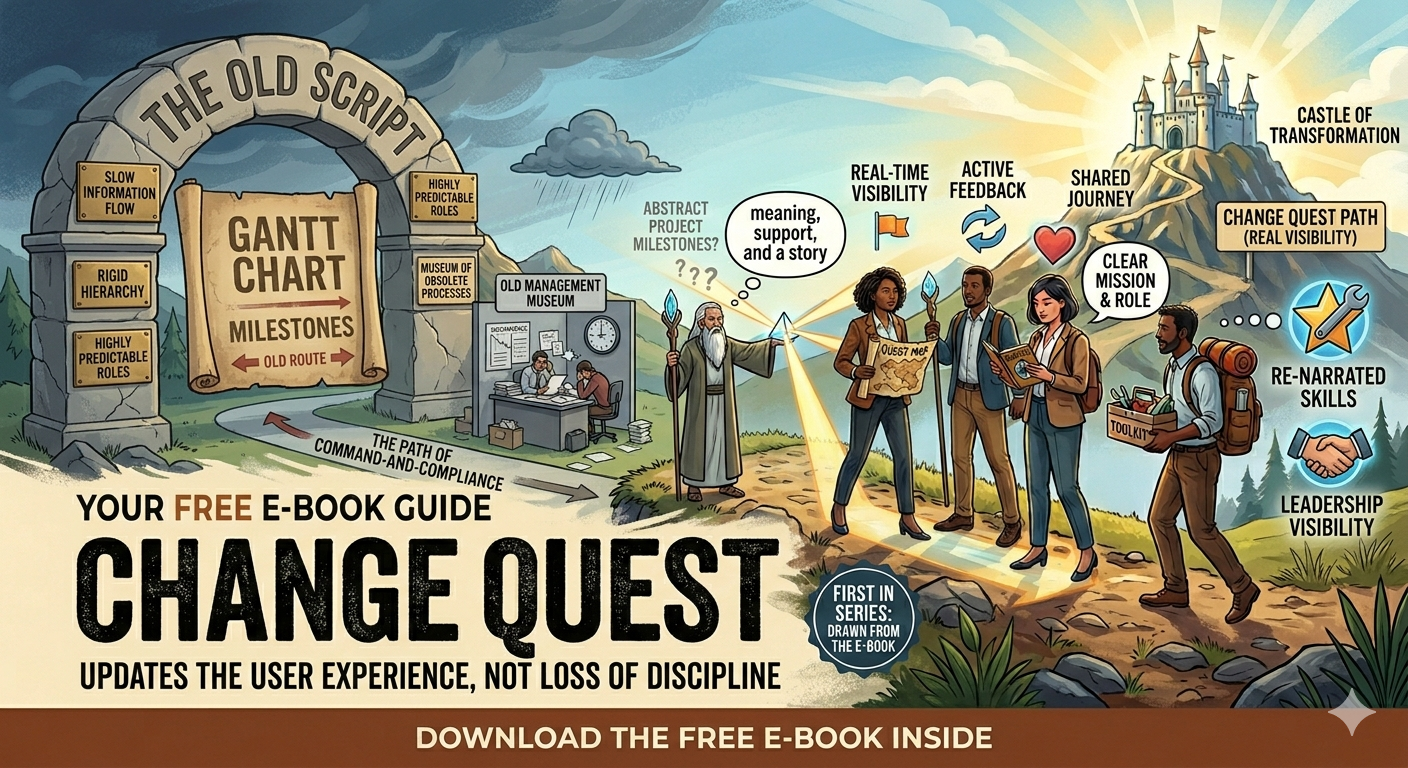
For a long time, organizations have tried to manage change using language and structures that made sense in a different era. The problem is not that our foundational tools were wrong. The problem is that the context has completely shifted, and the old script no longer fits the people who are living through change today.
Much of modern change practice was shaped in a world of slower information flow, more rigid hierarchies, and highly predictable roles. That made sense when organizations were built primarily for stability and control.
But today’s workforce is navigating digital tools, AI-assisted work, cross-functional teams, and constant adaptation. The way people experience change has shifted dramatically—even if the core principles of communication, sponsorship, and training still matter.
Change management does not need to abandon its foundations. It needs to re-narrate them. The underlying discipline can stay, but the story needs to change if we want people to truly connect with it.
The Old Language Problem
When we describe change as a project, an initiative, or a rollout, we are describing it in a way that fits governance, not human experience. The language is tidy, but it flattens the human reality underneath it.
People do not live inside a project plan. They live inside real, pressing questions:
- What does this mean for my daily workload?
- Do I have the skills to succeed in this new environment?
- Will leadership actually stay with us after the launch date?
This is exactly where the old script breaks down. It operated under the assumption that if the plan is clear, the people will automatically follow. In practice, people need more than a checklist. They need meaning, support, and a story they can recognize themselves in.
Why the Script Broke
A lot of organizational processes were designed for a very specific historical context, and they have lingered long after that context disappeared. The result? Some change efforts still sound like they belong to a museum of management. They are built for a world where information moved slowly and where people could simply be told what to do and expected to comply.
But that is not how modern change works.
OLD SCRIPT MODERN EXPECTATION
Slow, top-down information ➔ Real-time visibility & transparency
Command-and-compliance ➔ Active feedback & participation
Abstract project milestones ➔ Clear mission, role, & shared journey
People are infinitely more likely to engage when they can understand the mission, see their specific role, and feel that the journey has been designed with their reality in mind. The language of change matters just as much as the process itself.
The Quest Alternative
In The Change Quest, I use quest language to make the change journey more human, more memorable, and more usable. Instead of talking about abstract administrative steps, I frame the work as a mission, a terrain, a party, and a path forward.
Let’s be clear: This framing is not meant to make change playful for its own sake. It is meant to make change legible.
The goal is not to discard what traditional change management has taught us. The goal is to help people enter it more easily. When the story fits the lived experience, people are more likely to engage with the work instead of resisting it from the start.
Ready to update your organization’s script?
I go much deeper into this shift in the e-book, explaining how the Change Quest approach updates the user experience of transition without losing an ounce of project discipline. The free e-book is also available directly within the post for anyone who wants the full framework.
[Download the e-book here: The Change Quest]

 Life Horizons