
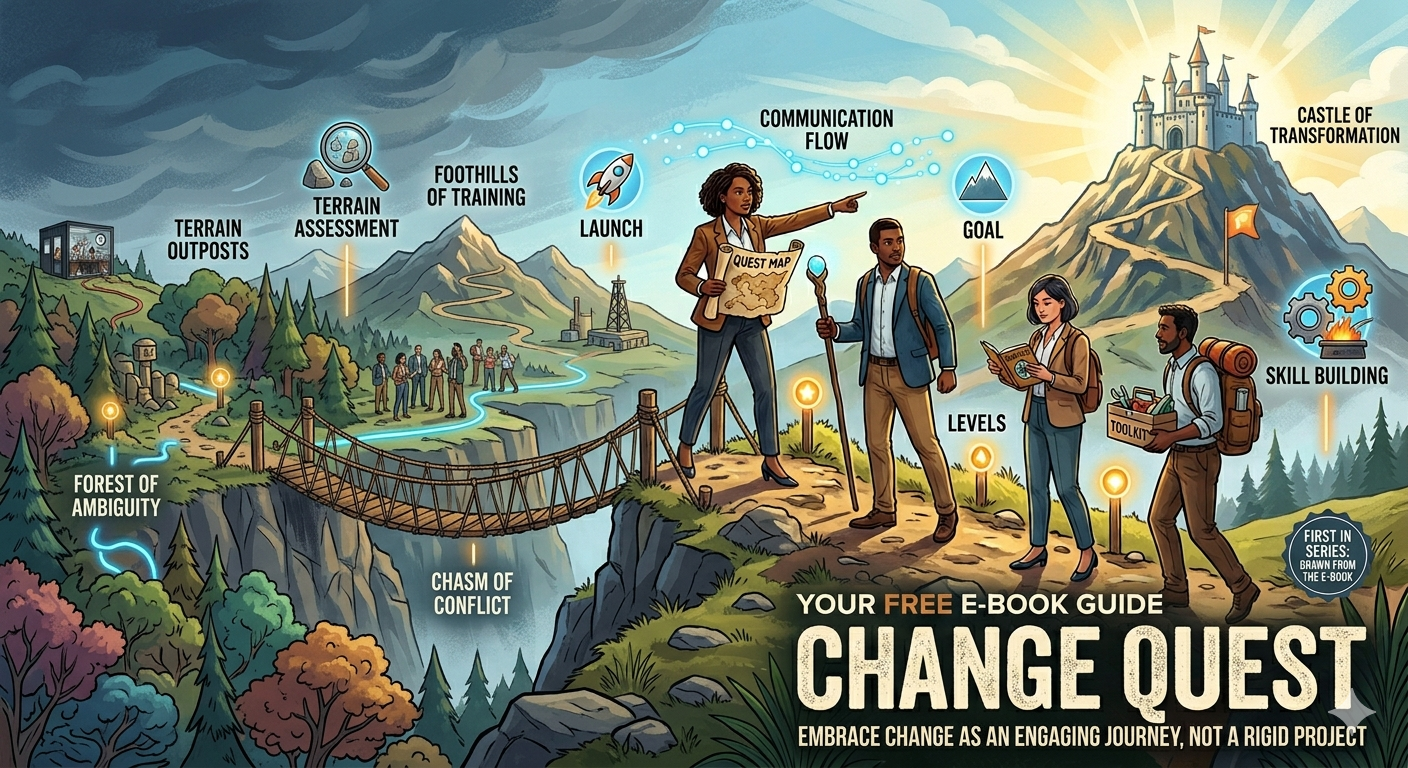
Change is not just a logical sequence of tasks. It is a human experience. It carries emotion, uncertainty, resistance, hope, fatigue, curiosity, and sometimes relief. If we reduce change to an IT issue, a process update, or a project milestone, we miss the reality of how change affects the workforce that must live with it.
This is the first in a series of posts drawn from my new free e-book, The Change Quest. In this series, I’ll share the core ideas behind the book and show how change management can be reframed as a more human, engaging journey. If the ideas resonate, you can download the e-book at the end of this post and send me your impressions.
The Human Reality of the Plan
A project plan is useful, but it is only one part of the picture. It gives us a logical series of steps to reach an end state. A change management plan has a different purpose. It acknowledges that people do not all move through change in the same way, that different groups are affected differently, and that transition requires more than task completion. It requires understanding, communication, support, and trust.
I saw the need for this approach in a very practical way during a digital transformation initiative. We were introducing a mobile financial application designed specifically for personnel deployed internationally—individuals who regularly operate outside the corporate firewalled network.
We had worked up the change plan meticulously and thought we were entirely ready. But we made a critical error: we missed a key stakeholder group. In our initial mapping, we completely overlooked the very people deployed on the ground who needed to use the application without standard network access.
The plan was logically sound, but it had a massive gap where human reality should have been. That gap mattered. It reminded me that a change plan can look perfect on paper and still fail in practice if it does not fully account for the people living inside the change.
Speaking the Language of the Workforce
As a result of that experience, I developed the 8-step Change Quest process. This structured method standardizes the journey, makes the planning work more complete, and ensures that no essential role or stakeholder group is missed.
The structure is designed to move from mission clarity to terrain assessment, party alignment, landscape analysis, communication flow, skill-building, launch, and reinforcement. In quest language, that means no one enters the journey without knowing the mission, the map, the party, or the path ahead.
But why use the language of a “quest”? Because language matters.
If we want people to move through transition, we need to speak in terms that help them recognize themselves in the journey. Technical language may make sense to project teams and governance groups, but it often does not help the broader workforce understand what the change means for them. The message must be translated into something relatable.
For today’s workforce, gaming language is a natural bridge. Many people already understand levels, missions, roles, feedback loops, progress indicators, and team-based journeys. They do not need the organization to invent a brand-new vocabulary from scratch. They need the change to be framed in a way that feels familiar, clear, and navigable.
Using quest language throughout the book is not about making change childish or trivial. It is about making change understandable, participatory, and safe.
The Journey Ahead
The goal is not to replace traditional change management. The goal is to give it a language that better reflects how people experience it. When change is framed as a quest, people can see their role more clearly. They can understand where they fit, what is expected of them, and how the journey unfolds.
Over the next few weeks, I’ll explore the steps of this framework one by one:
- Quest 1: The Mission Briefing – How the mission must be defined before the journey begins.
- Quest 2: Assess the Terrain – How the terrain reveals hidden human risks.
- Quest 3: Build the Party – How the party must be assembled with care, so no one is left behind.
- Quest 4: Understand the Landscape – How to prioritize who needs what and avoid one-size-fits-all engagement
- Quest 5: Design the Quest-Flow – How the quest itself needs a communication flow that keeps people informed, prepared, and engaged.
- Quest 6: Skill-Up the Quest Team – How to address capability gaps through practice rather than just slide decks.
- Quest 7: Launch the Quest Campaign – How to manage rollout as a smooth sequence rather than a sudden switch.
- Quest 8: Reinforce the Quest – How to ensure sponsor follow-through so new habits stick and become normal.
That is what change leadership should do: not simply manage tasks, but guide people through transition in a way that is clear, relatable, and meaningful.
Ready to reframe your organization’s journey?
[Download the free The Change Quest e-book here]
After you’ve had a look, leave a comment below or send me a message. I’d love to know what resonates, what challenges your thinking, and what specific steps you would like explored in deeper detail.

 Life Horizons