
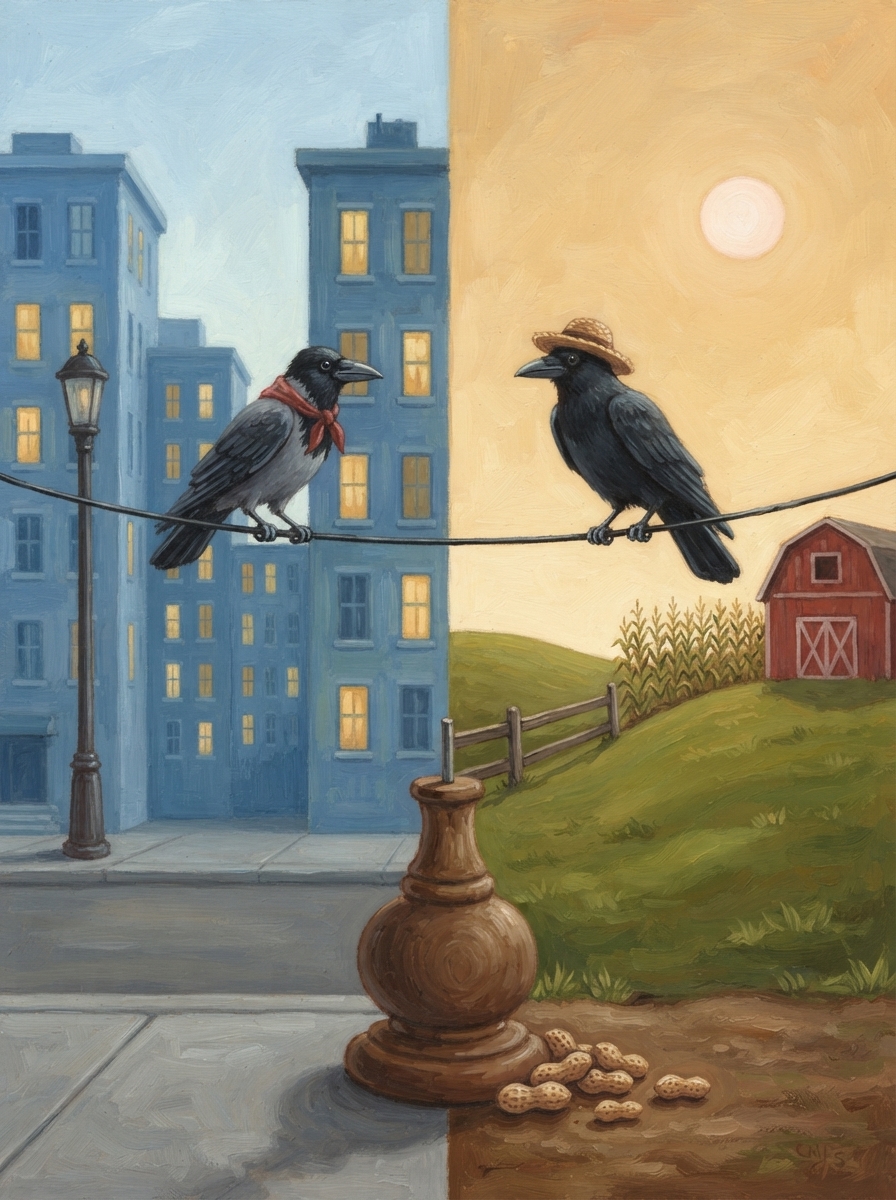
Introducing my new e-book, Carl and Chris Crow: A Tale of Two Perches
You probably know the old fable of the town mouse and the country mouse. Each one visits the other, each one is miserable away from home, and each goes back sure that his own way of living is best.
I’ve written a new version of that story, with crows. And then I’ve done something the old fable never did: I’ve dropped something into both their worlds that neither of them has ever seen before.
Meet Carl and Chris
Carl Crow lives on the third lamppost outside a busy food court, where buses hiss and something new turns up on the sidewalk every day. His cousin Chris lives on a fence post at the edge of a cornfield, where the corn grows, the wind blows and nothing much happens at all.
They agree on almost nothing, except that the finest food in the world is a peanut in the shell.
When Chris visits the city, a paper takeout box sends him circling and every passer-by sends him to the rooftop. He goes home hungry. When Carl visits the farm, the big-city crow freezes in front of an ear of corn. (“Why does it have rows?”) Each cousin is brave at home and nervous away.
Then one Monday morning, a heavy carved wooden thing appears beside the peanuts. In the city and in the country. It’s new to everyone, and nobody is the expert.
A journey, or a quest?
That’s where the story turns into something more than a fable.
Sir Ken Robinson drew a useful line between a journey, where you know where you’re going and when you’ll arrive, and a quest, where there’s real uncertainty and you have to find your way as you go. The cousins’ visits were journeys. The wooden thing starts a quest.
What follows is the crows of town and country working it out together: perching high and watching, learning from each other, a small brave crow named Pip going in first, a rush of overeager youngsters that ends in a great hollow THUNK, and Old Corvina, the eldest crow, whose rule has always been “When in doubt, fly.”
I won’t tell you how Corvina comes around. But I will tell you that the way her cousin Chris wins her over is the most useful change-management lesson in the book. He doesn’t argue with her. He asks about the times her rule saved her life.
The Change Quest Method, told through a story
The second half of the e-book steps out of the story and reads it as a case study using the Change Quest Method, the eight-step approach I’ve been developing for leading change that people take on together:
- Understand the Mission
- Assess the Terrain
- Map Your Quest Roles
- Understand the Quest Landscape
- Design the Quest-Flow
- Skill-Up the Quest Team
- Launch the Quest Campaign
- Reinforce the Quest
Nobody in the story makes a plan, yet the crows move through all eight quests anyway. For each one, the book shows where it happens in the story, what lesson it carries, and a Compass Check question you can ask on your own team on Monday morning. Questions like: For whom is this change the “corn”? and Whose resistance has a good reason, and have we asked them about it?
Grading the flocks with the Quest Compass
I also score both flocks with the Quest Compass, the tool I use to measure how people living through a change actually experience each step. Over one week, both flocks climb from a failing grade to 30 out of 40.
That sounds like a success. But one spoke of the compass is still short: Reinforce the Quest sits at just 2 out of 5. The crows remembered the answer (“it’s only a lamp base”) rather than the habit that got them there. A week later, Pip nearly walks into a real trap.
If you’ve ever watched a project hit its go-live, get declared a success, and then quietly unravel at the next change, you’ll recognise that moment.
Grounded in real crow science
The story isn’t just whimsy. It’s built on a study published in Behavioral Ecology by biologist Dave J. Colucci and Associate Professor Emerita Anne Clark of Binghamton University. They fed peanuts to ten urban crow families in Ithaca, New York, and ten rural families in nearby Dryden, then set out new objects beside the food (a rock, an ear of corn, a takeout box and a wooden lamp base) and watched what happened.
Among their findings: what feels “new” depends on experience; city crows were, surprisingly, the more cautious; country crows flee people early no matter where they’re looking; and city crows read the human gaze. Each of those findings shows up in the story, and the book’s closing section maps them chapter by chapter.
Who this book is for
- Leaders and change practitioners who want a memorable way to introduce change concepts to a team
- Anyone living through change at work who’s tired of being told to “embrace it”
- Facilitators and trainers looking for a story to open a workshop or spark discussion
- Readers of all ages who simply enjoy a good fable (the story half reads beautifully aloud)
It’s a short read, sixteen pages, and you can finish it over a coffee. But I hope the questions stay with you a good deal longer.
Get your copy
Carl and Chris Crow: A Tale of Two Perches is available now. Download the e-book here
And if the method catches your interest, the full approach is in my e-book The Change Quest Method, with an overview in my earlier post, The Change Quest: A Shared Journey Through Change.
Because as Carl and Chris discover, something new always turns up next Monday.


