
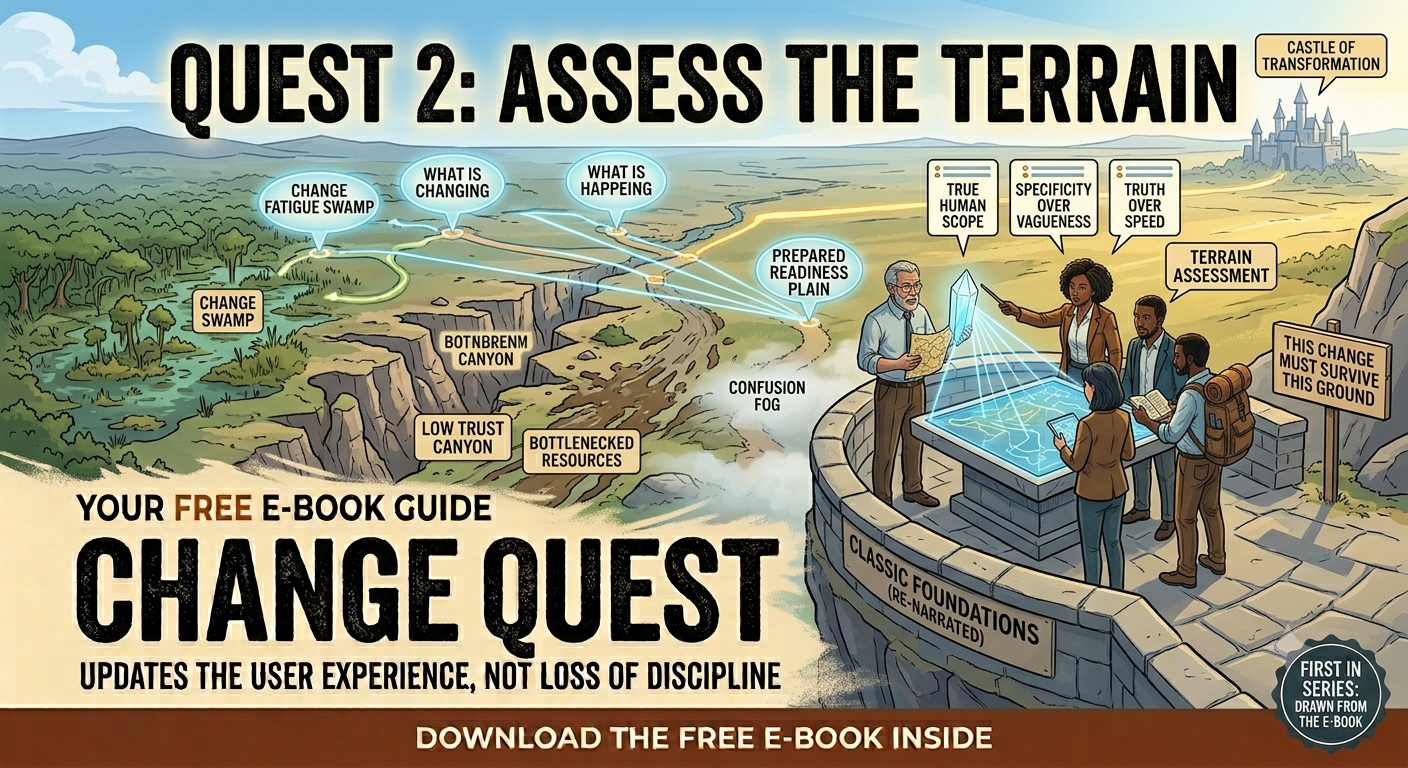
Once the mission is clearly defined, the next step is to assess the environment it will encounter. That is Quest 2.
In Quest 1, we gave the change its true shape. We defined what is shifting, what is staying the same, who is affected, and why the journey is necessary. That was the mission briefing. Now, we turn our attention to the terrain. Even a perfectly defined change can end up dead in the water if the organizational environment is completely unready to support it.
A change may make perfect sense on paper and still carry immense risk in practice. The question in Quest 2 is not whether your change is valid. The question is whether your organization is actually equipped to move through it.
Why the Terrain Matters
In quest language, the terrain is the actual ground your team has to cross. Some ground is firm and predictable. Some is shaky and unstable. Some paths are wide open, while others are bottlenecked, narrow, or full of hidden pitfalls. If you do not pause to understand the ground beneath you, you will inevitably choose the wrong route, the wrong pace, or the wrong level of support.
The exact same rule applies to change leadership.
A technically flawless solution will still fail if it lands in a tired, skeptical, overloaded, or low-trust environment. Leaders frequently focus so much on the brilliance of their solution that they completely forget to read the conditions surrounding it.
But change never happens in a vacuum. It happens inside a real organization filled with real people, real pressures, and a shared history.
The Human Factor of Risk
When corporate leaders hear the word risk, their minds jump straight to system dependencies, data migration, or delivery timelines. Those technical elements matter, but they are only a fraction of the story.
True change risk is fundamentally human.
A smooth path turns treacherous when:
- People are confused about the core purpose of the change.
- Teams are anxious about shifts in their daily workload, authority, or personal competence.
- Middle managers are unaligned and quietly pushing back.
- Sponsors vanish—standing highly visible at the launch party but nowhere to be found when real resistance appears.
- The workforce is fatigued, already carrying the exhausting weight of too many competing initiatives at once.
Any single one of these conditions dramatically increases your project risk. That is why a terrain assessment is far more than a standard checklist or a dry technical exercise. It is a way of seeing the human landscape clearly before you ask anyone to move.
If Quest 1 asks, “What is the change?” then Quest 2 asks, “What will this change have to survive to get to the other side?”
Readiness vs. Agreement
It is vital to understand that readiness is not the same thing as agreement.
Your people do not need to fall in love with the change to be ready for it. But they do need enough clear understanding, baseline confidence, and structured support to move forward without being left behind. They need to know why the shift is happening, what it means for their specific role, and exactly what safety nets will be there as they adapt.
SCOPE: Tells you how big the change is on paper.
READINESS: Tells you how well the organization can carry it.
An environment that is healthy and prepared can absorb a transition with a relatively light touch. A strained, fatigued, or highly skeptical environment will require significantly more resources, time, and visible leadership presence.
If scope alone tells the whole story is one of the most common mistakes in change leadership. Scope is just the size of the weight; readiness is the actual strength of the muscle trying to lift it.
Identifying High-Risk Ground
A change becomes high risk the exact moment size and readiness are out of balance. A massive project can look entirely different depending on the ground it lands on. The terrain becomes incredibly difficult to cross when these specific conditions show up together:
- Broad Impact: The change hits multiple distinct functions or departments simultaneously.
- Power Shifts: It fundamentally alters traditional roles, decision-making authority, or governance structures.
- Change Fatigue: It arrives in an organization that is already physically and mentally tired from previous rollouts.
- Low Trust: There is a history of broken promises or poor communication from leadership.
- The “Auto-Adoption” Trap: Leadership simply assumes adoption will happen automatically because “it’s a better system.”
How to Assess the Ground
A healthy terrain assessment requires asking exceptionally honest questions before you leap:
- Where are people most likely to push back, and is that pushback driven by fear, fatigue, or confusion?
- Which leaders will actively champion this, and which ones will quietly slow it down?
- What day-to-day operational pressures will make this change harder to absorb right now?
The ultimate value of Quest 2 is that it forces an organization to look before it leaps. It exposes the critical difference between a change that is merely technically possible and a change that is survivable for the people who have to live inside it.
Plans look clean and beautifully organized on a screen. But a plan that ignores fatigue, trust, and competing priorities does not reflect reality. That is when leaders get blindsided. They think they are walking down a smooth, paved path, while their team is already sinking into the mud. Reading the terrain correctly prevents that surprise entirely.
Ready to chart your organization’s ground?
Quest 2 keeps our change efforts honest by testing our grand missions against real-world environments. Once you understand the ground, you can begin looking closely at the people standing on it—who they are, how they connect, and the specific roles they will play in the journey. That is Quest 3: Build the Party.
You can download the complete Change Quest framework, including practical terrain assessment tools, for free directly within this series.
[Download the free Change Quest e-book here]
When leading a transition, how do you handle a terrain that is already suffering from heavy change fatigue? Let’s share strategies in the comments.

 Life Horizons