
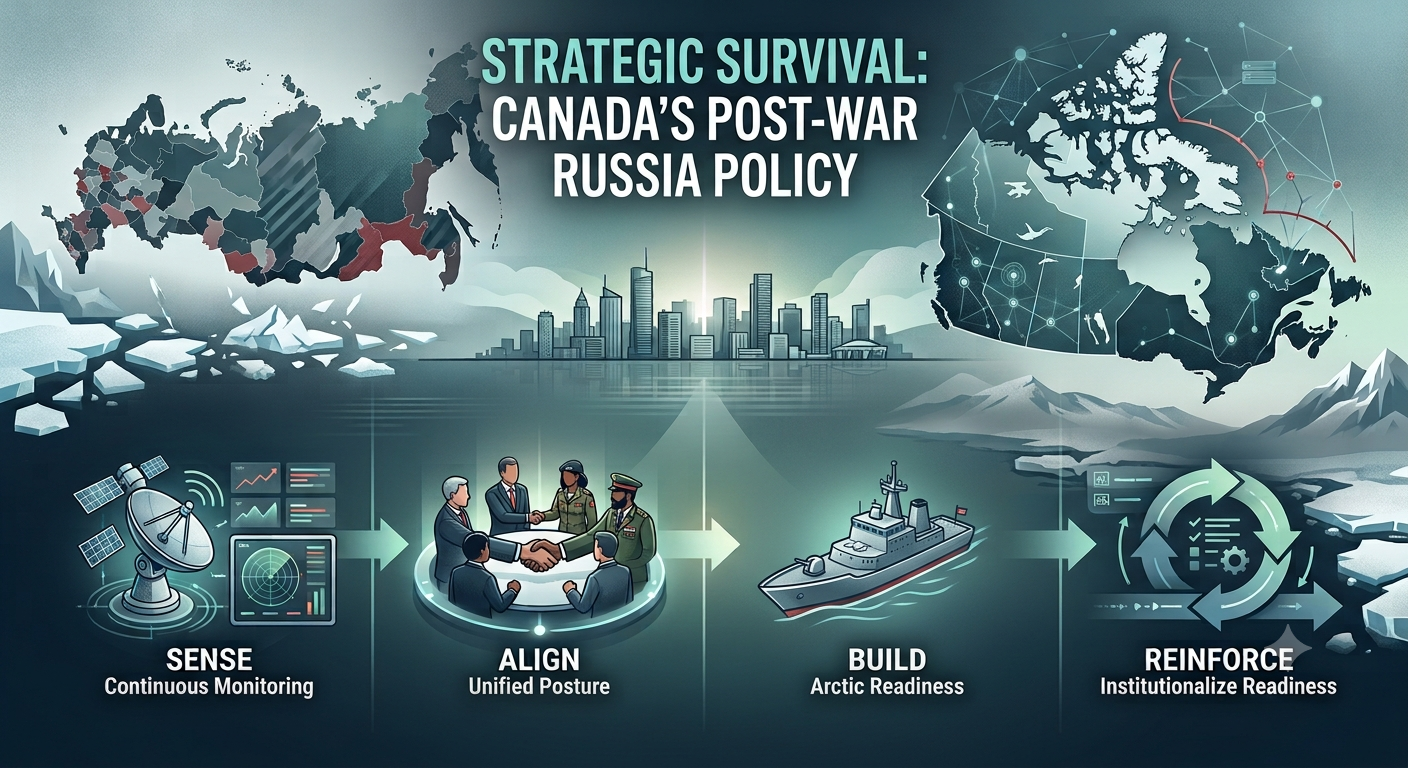
The Economist’s July 9, 2026, essay argues that post-war Russia could evolve into one of four destabilizing forms: a humiliated revanchist state, a dependent partner in China’s orbit, a fragmented nuclear risk, or a sealed fortress state. For Canada, the useful question is not which outcome will arrive, but how the country can build enough adaptive capacity to respond to any of them.
Canada can treat this as a change management challenge as much as a foreign-policy one. The task is to build situational awareness, alignment, and resilience across defence, diplomacy, intelligence, Arctic policy, energy security, and critical infrastructure so Canada can respond coherently under changing conditions.
Why this matters to Canada
Canada is already adjusting to a more dangerous and uncertain world. Ottawa’s Arctic Foreign Policy and defence policy update both stress that the Arctic is now a frontline of strategic competition, that Russia has intensified military and hybrid activity, and that closer integration with the United States, NATO, and Nordic allies is increasingly important. The practical lesson is simple: Canada can gain by preparing before a crisis forces the issue.
Change management offers a useful lens here. In a major transformation, leaders move through diagnosis, stakeholder alignment, capability-building, implementation, and reinforcement. For Canada, that means building a national change portfolio that connects security policy, public communications, industrial readiness, and community resilience into one coordinated approach.
Four Russia scenarios
1. A humiliated, revanchist Russia
If Russia emerges from the war weakened and humiliated, the risk may not be peace but resentment. The article argues that this could generate deferred energy and revanchism rather than durable stabilization. For Canada, that means planning for more, not less, volatility in Arctic approaches, cyber activity, information operations, and coercive diplomacy.
Canada can respond with deterrence plus de-escalation capacity. That means investing in Arctic domain awareness, NORAD modernization, and rapid-response communications so Canada can detect and respond early without escalating unnecessarily. It also means using change management tools like a clear case for change, leadership alignment, and consistent messaging so Canadians understand why resilience spending matters even after an apparent “end” to the war.
2. A Russia pulled into China’s orbit
The article’s second scenario is a Russia that becomes structurally dependent on China, trading strategic autonomy for markets, capital, and technology. For Canada, that could intensify the overlap between Arctic, Indo-Pacific, and North American security concerns, because the same networks of influence and surveillance may reinforce each other.
Canada can respond by deepening allied coordination and tightening risk controls around infrastructure, research security, and dual-use technologies. The policy implication is not blanket decoupling, but selective insulation: protect sensitive systems, diversify suppliers, and align intelligence-sharing across NATO and Indo-Pacific partners where interests overlap. In change terms, Canada may need modular adaptation rather than a single rigid strategy.
3. Fragmentation and nuclear instability
A fragmented Russia is the most dangerous scenario because it could create struggles over nuclear weapons, borders, resources, and legitimacy. For Canada, the core issue would be crisis containment, not victory or punishment.
Canada can prepare for this by strengthening contingency planning with allies, especially on nuclear risk reduction, border security, mass displacement, cyber disruption, and continuity of government. This is a classic readiness-and-response exercise: define triggers, rehearse decision pathways, and ensure roles are understood before the event occurs. Canada’s emphasis on allied interoperability, Arctic surveillance, and persistent northern presence already points in this direction, but it can be extended into explicit instability-contingency planning.
4. A fortress Russia
The final scenario is a closed, mobilized Russia that lives in permanent siege. The article warns that such a system turns conflict into a mode of governance and suppresses the innovation, trust, and openness needed for long-term stability.
For Canada, this means preparing for chronic hybrid pressure: disinformation, espionage, coercive energy and commodity politics, and long-duration strategic competition. The response can be endurance, not panic. Canada can build institutional habits that reinforce resilience over time—cross-government coordination, public trust, industrial capacity, and recurring strategy reviews—so the system does not drift into reactive, one-off crisis management. That is where change management is especially useful: reinforcing new norms until they become default practice.
What Canada can do now
A practical Canadian response can rest on five moves. First, institutionalize Russia scenario planning across federal departments, provinces, Indigenous governments, and allied channels. Second, accelerate Arctic sensing, communications, and logistics so Canada can operate in disrupted conditions. Third, harden critical infrastructure and supply chains against cyber, physical, and information attacks. Fourth, build public resilience through plain-language communication and regular scenario exercises. Fifth, align defence procurement and industrial policy so Canada can scale capacity faster when conditions change.
That is the heart of change management in a national-security context: not predicting perfectly, but preparing deliberately. Canada can avoid the trap of assuming that one post-war Russian outcome will be stable enough to plan around. Instead, it can build a flexible, whole-of-society posture that absorbs shocks, protects sovereignty, and coordinates action with allies.
Conclusion
The most useful question is not “what will Russia become?” but “how quickly can Canada adapt if any of these futures arrives?” The answer can be: quickly, coherently, and with enough organizational discipline to turn uncertainty into readiness.
Canada’s best preparation is a change-capable state: one that senses early, decides clearly, communicates consistently, and reinforces resilience across institutions and communities. In a world shaped by Russian volatility, Chinese leverage, and Arctic exposure, that is not just good policy. It can be strategic survival.


